Thursday, January 19, 2012

Attack Stirs Ethiopia, Eritrea Tensions

By Solomon Moore: The Wall Street Journal
NAIROBI—Tensions rose between Ethiopia and Eritrea on Wednesday, after officials from the two hostile east African neighbors blamed each other for the killing of five European tourists along their border.

Ethiopian spokesman Bereket Simon said gunmen who carried out Monday's attack in the Afar region of northeastern Ethiopia, about 25 kilometers from the Eritrean border, near the active Erta Ale volcano, were members of "subversive groups trained and armed by the Eritrean government." He didn't offer evidence to support his claim.

Eritrea's foreign ministry called the accusation a "ludicrous" smear campaign, saying in a statement that Ethiopia has long been host to home-grown, armed opposition groups. Eritrean officials said the attack took place in Ethiopian territory, and is an Ethiopian matter.

A European official said a group of European tourists came under attack from an armed group between 1 a.m. and 5 a.m. local time on Monday. The official didn't identify the armed group or its affiliation. Ethiopian and European officials said several of the tourists were taken captive.

A representative of Diamir Adventure Travel of Dresden, Germany, confirmed that the company had been involved, but declined to provide details of the attack, the number of travelers affected or the victims' nationalities. European officials said the five dead included nationals from Germany, Austria and Hungary.

Twelve members of the tourist group had been rescued and were being flown by an Ethiopian helicopter to Addis Ababa, according to Theresa Schönfeld, a spokeswoman with Germany's Foreign Ministry, who confirmed that at least two Germans were killed by gunmen.

And here is the rest of it.

Monday, January 2, 2012

The great Ethiopian land-grab: feudalism, leninism, neo-liberalism ... plus ça change

René Lefort
Courtesy of Gado Cartoons
Land in Ethiopia is being leased to agro-industry investors on very long terms and below market rates. The beneficiaries have good political connections. But then land has been the play-thing of centralising authoritarians throughout Ethiopia's recent history.  

Ethiopia is the world champion of “land grabbing” – the practice of renting out vast expanses of farmland to local and, in particular, foreign investors. In 2011, 3.5 million hectares were allocated, while the projected figure for 2015 is 7 million hectares, an area twice the size of Belgium.[i] By way of comparison, 12 million hectares are farmed by the same number of smallholders, who make up four-fifths of the Ethiopian workforce. It is not hard, then, to imagine the anticipated leap forward in agricultural output, especially given that the productivity of these new mechanised farms should be much greater than that of traditional peasant farmers. As a first approximation, medium sized yields and export of just half of their production should, in the medium term, bring in about US$ 10 billion in foreign currencies, at a time when the deficit in the balance of payments is the Achilles heel of the Ethiopian economy and its GDP currently stands at US$ 30 billion.

And here is the rest of it.

Ethiopia: OLF drops secession, embraces Ethiopian unity

By Abebe Gelaw

Washington DC (ESAT)– The Oromo Liberation Front has announced its historic decision to drop its long-held secessionist agenda and to embrace the unity of Ethiopia under a genuine federal arrangement that must guarantee the rights, equality and liberty of all Ethiopians.
In a historic press release, the OLF, led by Brigadier General Kemal Gelchu, issued at the conclusion of its extraordinary National Council plenary, held on December 30 and 31 in Minnesota, the front spelt out its new vision in an unprecedented clarity. The meeting was also open to any non-Oromo Ethiopians for the first time.
 
 
According to the press release, the OLF National Council has examined the struggle of the Oromo people, the political program of the front, the prevailing conditions that the Ethiopian people suffer under the dictatorship of Meles Zenewi and the necessity of working with all democratic forces in Ethiopian to end the untold misery of Ethiopians under the tyrannical regime.
“The OLF National Council also focused on the timely demand of working with other democratic forces in forming the new Ethiopia that will guarantee and protect the fundamental rights of all peoples in Ethiopia. The new social contract will and should be based on the free will and consent of all peoples in Ethiopia. The previous style that claims “I know for you” should be abolished and replaced with a new vision that is based on peoples’ consent and free will,” the release stated.


The historic statement further noted that OLF would struggle not only for the Oromo people but also the people of Ethiopia suffering under the tyranny and oppression of the TPLF regime. “To fulfill this vision and play crucial roles, not only for the Oromo people, but for all Ethiopian people, the OLF National Council pursuant to the power vested to it by the OLF National Congress effectively amended the OLF political program today, January 1, 2012,” the front said.
The release underscored the fact that the revised OLF political program will “accept the new federal democratic republic of Ethiopia that will work for the betterment of all of its citizens, neighboring countries and international communities.” It also said that the OLF would honor and respect the decisions of the Ethiopian people would make exercising their will under the new federal republic of Ethiopia.
OLF also urged all democratic forces to work in tandem to make Ethiopia a common home for all its people. It also called on the international community to desist from supporting the tyrannical regime of Meles Zenawi that is “engaged in terrorizing the Ethiopian people, selling the precious resources of the country to the highest bidders, and the government that does not respect the principles of democracy, human rights and rule of law.”
In an interview with ESAT Radio, Dr. Nuro Dedefo, OLF Executive Committee member, has explained that the front has charted out a new vision based on the reality on the ground. He said the new vision of the OLF aspires to liberate the Ethiopian people from the brutal minority rule of the TPLF and establish a new democratic Ethiopia based on the free will of the people to live, work and set up a common country for all. He pointed out that previously OLF used to advocate for the establishment of an Oromo state. As per its new vision, OLF now aspires to establish one country with other Ethiopians, he explained.


Dr. Nuro also underscored that OLF rejects the bogus federal arrangement that has imposed the hegemony of the TPLF on the rest of Ethiopia. According to Dr. Nuro, the OLF wants a real and genuine federal system which clearly shows that OLF broken with the past and embraced Ethiopian unity. “In order to change the racist minority rule of the TPLF and form a new Ethiopia that will be free from absence of the rule of law and rampant abuse of citizens… OLF is ready to work with all Ethiopian democratic forces,” he declared.
He noted that TPLF’s so-called federal arrangement has been designed to divide and rule the people of Ethiopia and impose its hegemony using its servile puppets and messengers. Dr. Nuro has underlined that that OLF’s new vision will put an end to TPLF’s propaganda against OLF, which it tried to present as a secessionist force. “That will put the scheme in the coffin once and for all,” he said.
The OLF official also called upon fellow Ethiopians to work with the OLF in a spirit of trust in order to establish the new Ethiopia, where democracy, justice, respect for human rights and rule of law will be the founding values.
Dr. Nuro told ESAT that the meeting, which was also open for non-Oromo Ethiopians, was exciting to so many Ethiopians that have already endorsed OLF’s new vision that it adopted to end dictatorship, suffering and lawlessness in Ethiopia once and for all in collaboration with any democratic forces.

Tuesday, December 27, 2011

Two Swedish journalists who entered Ethiopia with Somali rebel group are jailed for 11 years

Mail Online

  • Johan Persson and Martin Schibbye found guilty of supporting terrorism
  • Accused of making journey into Ethiopia from London
  • Lawyer says they are considering an appeal
  • EU raises concerns about freedom of media in Ethiopia
  • Johan Persson and Martin Schibbye found guilty of supporting terrorism

  • Two Swedish journalists have been jailed for 11 years after illegally entering Ethiopia with a Somali rebel group.
    A judge ruled that the two freelances - Johan Persson and Martin Schibbye - must serve 'rigorous imprisonment' following their convictions for supporting terrorism last week.
    Ethiopian troops captured them six months ago during a clash with rebels in eastern Ethiopia's troubled Somali region, a no-go area for reporters.
    And here is the rest of it.

    Tuesday, December 13, 2011

    Opposition Leader Labels Ethiopian Government 'Dictatorship'

    Peter Heinlein, VOA
    The newly elected leader of Ethiopia's largest opposition group says his party faces a monumental task in trying to unseat what he calls "dictators" bent on silencing dissent. The party held leadership elections even as some of its top officials are being tried on terrorism charges. Hundreds of regional party leaders clapped in approval as former Ethiopian president Negasso Gidada was elected head of Unity for Democracy and Justice, the largest faction of the Medrek (Forum) opposition coalition. The election was the first since former UDJ leader Birtukan Mideksa fled into exile earlier this year after being freed from prison, where she had been serving a life sentence. Negasso's acceptance speech was sober, free of the celebration that often accompanies victory. He called for the release of Andualem Arage and Natnael Mekonnen, two rising stars in the party who are on trial in federal court on terrorism charges. They, along with journalist Eskinder Nega, face the death penalty if convicted. Negasso called on Prime Minister Meles Zenawi's ruling party to open up political space for opposition parties to operate freely. In a VOA interview, he charged that while publicly advocating democracy, the ruling Ethiopian Peoples' Revolutionary Democratic Front, the EPRDF, is intent on suppressing dissent and creating a one-party state. “The system is from the old communist, it is the Marxist-Leninist way of thinking, and that is why we see, for example, that it is working with the Chinese Communist Party, because they have the same kind of belief. Therefore, it's a character of EPRDF to say it is the only one which is correct and it has to lead.” Negasso said the current system makes it impossible for the opposition to win elections. He said the only hope for changing the government is through peaceful struggle. “We have seen dictators cannot exist forever. We have seen that," said Negasso. "At one time, the people will say no. It may not happen this year, or after two years or so, but at some time the people will be angry and will stand up. That's what is going to happen.” Negasso expressed particular concern about what he called a trend to use the state-run media to demonize opposition groups. He pointed to a recent three-part series on state television called Akeldama, or Land of Blood. The program suggested that UDJ leaders such as Andualem and Natnael were using their political work as a cover for terrorist activities linked to the outlawed Ginbot Seven party. “Even if they had connection with Ginbot Seven, which the government thinks is terrorist, what the program did was accuse people as criminals and then try to prove what it says by bringing fake evidences, and giving judgment," he said. "People who are accused are innocent until proven by the court. What the program did is a big violation of the constitution.” Government spokesman Shimeles Kemal, a former prosecutor, said the purpose of the Akeldama series was to warn citizens about the threat of terrorism. In a phone interview, Shimeles said opposition groups have been warned to guard against terrorist infiltrators. “Medrek and some of its member party organizations have made themselves vulnerable to get infiltrated by terrorist elements," he said. "And the police have time and again advised these organizations to check through their own internal recruiting criteria as well as internal mechanisms so as to sift out infiltrators from their local members.” Shimeles defended the decision to air Akeldama at a time when Andualem, Natnael and Eskinder are on trial, facing the death penalty. He said the government's Anti-Terrorism Task Force has a duty to disclose its activities to the public, adding “This is perfectly in accord with any democratic practice, including in the United States."

    A climate of corruption, Ethiopian edition

    By Janice Winter, Daily Maverick
    COP17 is being hailed as “groundbreaking” as a deal was agreed after 14 days of difficult and, at times, deadlocked talks. One of the most contentious issues for Africa was the Green Climate Fund, which will go ahead despite anger at the overall failure of developed countries to commit investments. JANICE WINTER explains why this compromise is the best possible scenario.

    Headlines last week declared: “Meles Zenawi cries foul over climate money pledges”. Well, that’s rich.

    Leading Africa’s heads of state and government panel at the COP17 climate talks in Durban, the Ethiopian prime minister’s biggest emphasis was on the Green Climate Fund. Not only did he complain that funds pledged at Copenhagen COP15 in 2009 had failed to materialise, but also that, rather than being “new” money, much of it seems set to be recycled from existing aid budgets. He warned that such disingenuousness risked undoing the modest gains made towards the Millennium Development Goals and undermining the credibility of the entire process “in the eyes of the people of our whole continent”.

    His position seemed reasonable enough: there was compelling scientific evidence that climate change will have a disproportionate impact on socio-economic development in Africa and that considerable financial investments were required from developed countries to assist Africa to adapt to the impact of climate change. But I am “of this continent” and something else risks undermining the credibility of the process in my view: that a corrupt dictator is provided with such an influential platform from which to hijack a critical cause for his own, probably illicit, interests. Coming from Meles, statements about credibility are hypocrisy at its most nauseating.

    The Green Climate Fund is aiming for about $100-billion a year by 2020. The man clamouring for this considerable fund is regarded as one of the most repressive leaders on the continent. His government claims to have won a ludicrous 99.6% in the 2010 elections, jails the highest number of journalists in Africa using a law that criminalises dissent as terrorism and brutally tortures critics and opposition figures. Most crucial for this discussion, his government faces widespread, credible and sustained allegations of abusing Ethiopia’s enormous $3-billion of annual developmental aid as a tool of political repression and as a co-option mechanism to bolster his 20-year rule. Detailed and robust investigations include those by Human Rights Watch, The Bureau of Investigative Journalism, and Newsnight.

    According to a report to be published by Global Financial Integrity later this month, Ethiopia has lost $11.7-billion to outflows of illicit funds in the last decade. In 2009 alone, the figure was $3.26-billion, exceeding both the value of its total annual exports and the total development aid it received that year. And it is on the increase. The candid finding: “The people of Ethiopia are being bled dry. No matter how hard they try to fight their way out of absolute destitution and poverty, they will be swimming upstream against the current of illicit capital leakage.”

    Yet despite these exposés and a significant deterioration in the country’s human rights situation since the brutal post-election crackdown of 2005 (in which 199 people were killed in just four days), international development aid to Ethiopia has doubled since 2005. Something as critical as the Green Climate Fund should not repeat the serious failures of developmental aid in this regard.

    Meles Zenawi’s international credibility lies largely in Ethiopia’s official double-digit annual growth rates since the questionable 2005 elections and its asserted progress towards the Millennium Development Goals. As exiled Ethiopian journalist Abiye Teklemariam writes, Meles has forged an image as “a technocratic, if dictatorial, leader who had been able to crack the code of east Asia’s rise and download it into an Ethiopian hardware.”

    Conveniently for Meles, no independent institutions in Ethiopia exist to check the veracity of his government’s figures, despite the credible scepticism by some international economists and substantial discrepancies in conclusions about Ethiopia’s performance and progress toward the MDGs. Indeed, the average growth rate for Meles’ entire 20-year rule (including the purported fast-paced period of the past few years) is less than 5% (below the African average of 6%) and that the country only overtook its 1975 GDP in 2006. Even if we take his spectacular recent figures at face value, which would be very generous, these are not representative of his rule. And despite these impressive, if contentious, figures, the Ethiopian economy is characterised by very high inflation, widespread unemployment, a stagnant private sector and corruption.

    Before the enormous intended investments are endowed to the Green Climate Fund, far closer interrogation is needed of the ways in which this money might be spent and by whom – whether, in fact, there would be effective guarantees that the funds would be spent on projects to counteract the impacts of climate change, or would instead risk being used by undemocratic leaders such as Meles to counteract the challenges of political opposition and dissent.

    The figures for the Green Climate Fund have been calculated by the African Climate Policy Centre, based in Addis Ababa. As it currently stands, African countries and institutions would be eligible for direct access to the fund. Oh, and some of these countries would also be part of the governing structures ensuring their own transparency and accountability.

    Before the Green Climate Fund becomes operational and offers developing countries direct access to significant sums of money, it is vital to establish firm eligibility criteria of countries based on an independent corruption index and a strong accountability mechanism to ensure funds are spent transparently. This is necessary to prevent the situation of other aid endeavours where direct access to funding and weak accountability procedures enable corrupt and undemocratic governments to augment their rule through the politicisation of foreign funding.

    If the Arab Spring has taught democratic leaders and donor nations anything, it is surely the need for far greater caution before financially assisting – and inadvertently bolstering – repressive leaders and a climate of corruption. DM

    Saturday, December 10, 2011

    As winter begins, an African Spring heats up

    By John Lloyd, Reuters


    The Arab Spring’s effects continue to ripple outward. As Tahrir Square fills once more, it gains new momentum. For months now, the autocrats of Africa have feared it would move south, infecting their youth in often-unemployed, restless areas.

    That fear has come to the ancient civilization of Ethiopia, the second-most populous state (after Nigeria) in Africa. There, since June, the government of Prime Minister Meles Zenawi has cracked down hard on dissidents, opposition groups and, above all, journalists, imprisoning some and forcing others into exile.

    The latest refugee is Dawit Kebede, managing editor of one of the few remaining independent papers, the Awramba Times. Kebede, who won an award for freedom from the US-based Committee to Protect Journalists last year, fled to the U.S. last month after he received a tip off that he was about to be arrested.

    Also in the past month, apparently reliable reports have circulated of a teacher in his late twenties, Yenesew Gebre, who burnt himself alive in protest against political repression in his home town of Dawra, in the south of the country. It has also been reported, by sources who spoke to the opposition satellite station, ESAT, based in the US, that Gebre had been dismissed from his teaching post because of his political views.

    The move recalls the self-immolation of Mohamed Bouazizi – another young man in his twenties – in Sidi Bouzid, Tunisia in January this year, a catalyst for the protests there and elsewhere in the spring. The parallel is being widely made in oppositionist sites and media.

    One of the oppositionists in exile is a journalist who, with others, founded a newspaper in October 2007, named Addis Neger. It was tolerated for two years, then closed down in December 2009. The founders, fearing arrest, left the country: Abiye Teklemariam came to the UK, where I spoke with him.

    “The self immolation of Yenesew Gebre is an extraordinary thing,” he said. “The more so since it’s absolutely not in the tradition of Ethiopia to take one’s own life like this. It is an expression of how far people are prepared to go, how frustrated they are. Part of the problem is that the foreign states who give aid – like the United States and the United Kingdom – don’t seem to care. The government now says that because it has strong growth, civil rights must suffer. And the foreign donors have accepted that: so there is no pressure on the regime.”

    Ethiopia isn’t, for the most part, like the Arab states who rose in different kind of revolts this past year. It’s bigger than most – with a population of some 82 million it’s slightly bigger than Egypt – and though still poor, it’s been growing strongly in the past decade. It also has a parliament with elections and opposition parties, which have had seats in the parliament.

    In the 2005 elections, the opposition groups won about one third of the parliament’s 546 seats. After that, however, oppositionists say there was a massive crackdown on the opposition, who engaged in widespread protests against what they saw as rigged elections. Some 200 people died in these protests, mostly at the hands of the security forces.

    Among the biggest political victims of the crackdown was Dr. Berhanu Nega, an academic and businessman, who was elected mayor of the capital, Addis Ababa, and whose party, the Coalition for Unity and Democracy, achieved just under 20 percent of the vote in the national election. With other leaders of his party, he was imprisoned, released in 2007 and fled to the US. There he has created an opposition party in exile, Ginbot 7, which calls for a revolutionary overthrow of the government of Prime Minister Zenawi, who has led the country since August 1995.

    In the last elections, in May 2010, the government claimed over 99 percent of the parliamentary seats for its main party, the Peoples Revolutionary Democratic Front, and its allies. Zenawi, in a public address after the poll, said any repeat of the 2005 protests would not be tolerated. Ginbot 7, and other oppositionist groups, have been labeled as terrorists: Nega has been sentenced to death in absentia.

    The Ethiopian government was asked, through its embassy in London, for a response to charges of repression, but they declined to comment.

    I called Ephraim Madebo, spokesman for Ginbot 7, who is based in New York, to ask him if there was any possibility of a rapprochement between the many oppositionist groups and the government, so that open elections might take place. He said that “there is no chance whatsoever. They are using laws, especially the media law and the anti-terrorist law introduced after 2005 to put their enemies in jail or drive them to exile. You cannot win democratically against the government. People must rise against it. And the government knows something is coming. They just don’t know when”.

    One of the outstanding opponents of the regime is Eskinder Nega (no relation to Dr. Nega), a US-educated journalist and newspaper publisher, who was imprisoned with his wife after the 2005 elections. His wife gave birth to his son in prison, though she and the child were later released. Eskinder, however, remains in prison. According to Madebo in New York, he has issued calls for Ethiopians to “fight like the people have done in Egypt, in Tunisia, in Libya”.

    In London, Teklemariam has also been labeled as a terrorist – though unlike Ginbot 7, he opposes any use of violence against the regime – and he has been told that Ethiopia will ask the UK to extradite him (the two countries have no extradition treaty, so that is unlikely to happen). He’s less optimistic than Madebo: he says that “the space for collective action is very limited – even though it is growing, if slowly.”

    Teklemariam thinks that, as in the Arab states, the internet and the social media networks are crucial to the development of a widespread movement – but Ethiopia lacks both. The net is largely confined to the capital, and social media users are few: in large part, he says, because the government ensures that connections are very slow and often dysfunctional.

    The Ethiopian elite is small and badly served by communication, but Teklemariam says that “it really matters in Ethiopia. So the government has to make it hard for them to communicate. There was very little access to news about the Arab Spring.”

    You can see why some African governments want to suppress news of the revolts in the north. Their transplantation south, and their even partial success, means loss of power, loss of wealth – or even, if it comes to outright conflict, loss of life (the jerky videos of the last minutes of Gadaffi’s life are a hideous toxin for all autocrats). Ethiopia’s rulers have sought a prophylactic against such radicalism in preventative arrests, seeking to neutralize all those who might lead or give shape to dissent.

    But Gaddaffi’s end spells a lesson other than suppression. It is to allow and encourage the growth of democratic habits and freer speech. For one of the few hopeful signs in this doom-laden world is that suppression now works badly, for shorter periods, and that a democratic opening may find men and women willing to make it work. As we enter winter, spring may come again.
    ______________________________
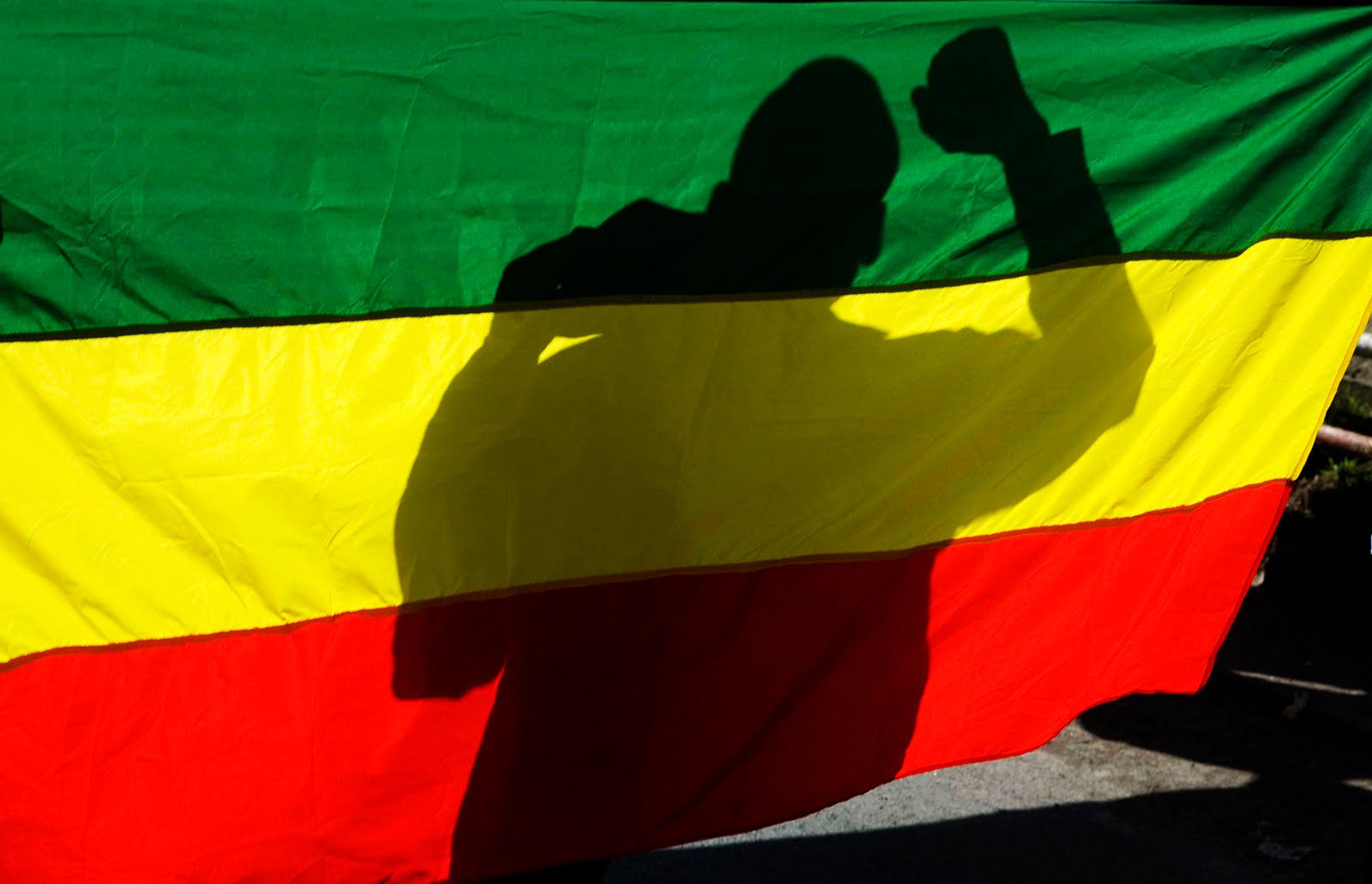
    Photo: The shadow of a supporter of Ethiopia’s Unity for Democracy and Justice party (UDJ) is seen through an Ethiopian flag during a demonstration in the capital Addis Ababa, April 16, 2009. REUTERS/Irada Humbatova
    ______________________________