Saturday, December 10, 2011

As winter begins, an African Spring heats up

By John Lloyd, Reuters


The Arab Spring’s effects continue to ripple outward. As Tahrir Square fills once more, it gains new momentum. For months now, the autocrats of Africa have feared it would move south, infecting their youth in often-unemployed, restless areas.

That fear has come to the ancient civilization of Ethiopia, the second-most populous state (after Nigeria) in Africa. There, since June, the government of Prime Minister Meles Zenawi has cracked down hard on dissidents, opposition groups and, above all, journalists, imprisoning some and forcing others into exile.

The latest refugee is Dawit Kebede, managing editor of one of the few remaining independent papers, the Awramba Times. Kebede, who won an award for freedom from the US-based Committee to Protect Journalists last year, fled to the U.S. last month after he received a tip off that he was about to be arrested.

Also in the past month, apparently reliable reports have circulated of a teacher in his late twenties, Yenesew Gebre, who burnt himself alive in protest against political repression in his home town of Dawra, in the south of the country. It has also been reported, by sources who spoke to the opposition satellite station, ESAT, based in the US, that Gebre had been dismissed from his teaching post because of his political views.

The move recalls the self-immolation of Mohamed Bouazizi – another young man in his twenties – in Sidi Bouzid, Tunisia in January this year, a catalyst for the protests there and elsewhere in the spring. The parallel is being widely made in oppositionist sites and media.

One of the oppositionists in exile is a journalist who, with others, founded a newspaper in October 2007, named Addis Neger. It was tolerated for two years, then closed down in December 2009. The founders, fearing arrest, left the country: Abiye Teklemariam came to the UK, where I spoke with him.

“The self immolation of Yenesew Gebre is an extraordinary thing,” he said. “The more so since it’s absolutely not in the tradition of Ethiopia to take one’s own life like this. It is an expression of how far people are prepared to go, how frustrated they are. Part of the problem is that the foreign states who give aid – like the United States and the United Kingdom – don’t seem to care. The government now says that because it has strong growth, civil rights must suffer. And the foreign donors have accepted that: so there is no pressure on the regime.”

Ethiopia isn’t, for the most part, like the Arab states who rose in different kind of revolts this past year. It’s bigger than most – with a population of some 82 million it’s slightly bigger than Egypt – and though still poor, it’s been growing strongly in the past decade. It also has a parliament with elections and opposition parties, which have had seats in the parliament.

In the 2005 elections, the opposition groups won about one third of the parliament’s 546 seats. After that, however, oppositionists say there was a massive crackdown on the opposition, who engaged in widespread protests against what they saw as rigged elections. Some 200 people died in these protests, mostly at the hands of the security forces.

Among the biggest political victims of the crackdown was Dr. Berhanu Nega, an academic and businessman, who was elected mayor of the capital, Addis Ababa, and whose party, the Coalition for Unity and Democracy, achieved just under 20 percent of the vote in the national election. With other leaders of his party, he was imprisoned, released in 2007 and fled to the US. There he has created an opposition party in exile, Ginbot 7, which calls for a revolutionary overthrow of the government of Prime Minister Zenawi, who has led the country since August 1995.

In the last elections, in May 2010, the government claimed over 99 percent of the parliamentary seats for its main party, the Peoples Revolutionary Democratic Front, and its allies. Zenawi, in a public address after the poll, said any repeat of the 2005 protests would not be tolerated. Ginbot 7, and other oppositionist groups, have been labeled as terrorists: Nega has been sentenced to death in absentia.

The Ethiopian government was asked, through its embassy in London, for a response to charges of repression, but they declined to comment.

I called Ephraim Madebo, spokesman for Ginbot 7, who is based in New York, to ask him if there was any possibility of a rapprochement between the many oppositionist groups and the government, so that open elections might take place. He said that “there is no chance whatsoever. They are using laws, especially the media law and the anti-terrorist law introduced after 2005 to put their enemies in jail or drive them to exile. You cannot win democratically against the government. People must rise against it. And the government knows something is coming. They just don’t know when”.

One of the outstanding opponents of the regime is Eskinder Nega (no relation to Dr. Nega), a US-educated journalist and newspaper publisher, who was imprisoned with his wife after the 2005 elections. His wife gave birth to his son in prison, though she and the child were later released. Eskinder, however, remains in prison. According to Madebo in New York, he has issued calls for Ethiopians to “fight like the people have done in Egypt, in Tunisia, in Libya”.

In London, Teklemariam has also been labeled as a terrorist – though unlike Ginbot 7, he opposes any use of violence against the regime – and he has been told that Ethiopia will ask the UK to extradite him (the two countries have no extradition treaty, so that is unlikely to happen). He’s less optimistic than Madebo: he says that “the space for collective action is very limited – even though it is growing, if slowly.”

Teklemariam thinks that, as in the Arab states, the internet and the social media networks are crucial to the development of a widespread movement – but Ethiopia lacks both. The net is largely confined to the capital, and social media users are few: in large part, he says, because the government ensures that connections are very slow and often dysfunctional.

The Ethiopian elite is small and badly served by communication, but Teklemariam says that “it really matters in Ethiopia. So the government has to make it hard for them to communicate. There was very little access to news about the Arab Spring.”

You can see why some African governments want to suppress news of the revolts in the north. Their transplantation south, and their even partial success, means loss of power, loss of wealth – or even, if it comes to outright conflict, loss of life (the jerky videos of the last minutes of Gadaffi’s life are a hideous toxin for all autocrats). Ethiopia’s rulers have sought a prophylactic against such radicalism in preventative arrests, seeking to neutralize all those who might lead or give shape to dissent.

But Gaddaffi’s end spells a lesson other than suppression. It is to allow and encourage the growth of democratic habits and freer speech. For one of the few hopeful signs in this doom-laden world is that suppression now works badly, for shorter periods, and that a democratic opening may find men and women willing to make it work. As we enter winter, spring may come again.
______________________________
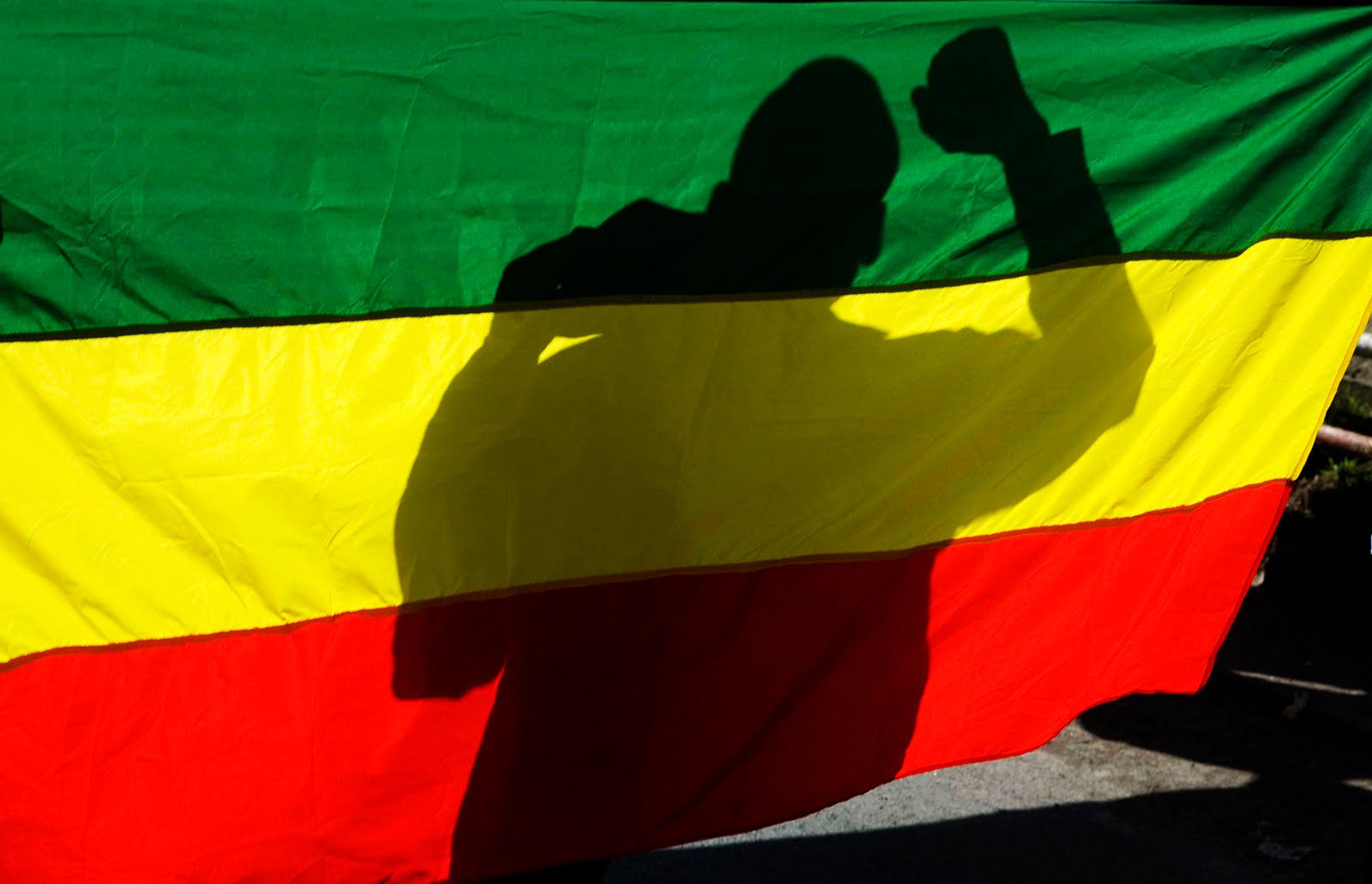
Photo: The shadow of a supporter of Ethiopia’s Unity for Democracy and Justice party (UDJ) is seen through an Ethiopian flag during a demonstration in the capital Addis Ababa, April 16, 2009. REUTERS/Irada Humbatova
______________________________
Thursday, December 8, 2011

Ethiopian Court Mulls Journalists' Role in Conflict Zones

By Peter Heinlein, VOA
The trial of two Swedish journalists charged with supporting terrorism in Ethiopia has ended with a discussion of the role of reporters in conflict zones.

The defense wrapped up its case by calling two veteran foreign correspondents as witnesses.

A three-judge Ethiopian federal court panel is to hand down a verdict December 21 in the case of freelance journalists Martin Schibbye and Johan Persson. The pair are charged with offering support to the Ogaden National Liberation Front (ONLF), a rebel group Ethiopia has labeled a terrorist organization.

Schibbye and Persson were arrested June 30 in the company of ONLF fighters, after a gunbattle between the rebels and Ethiopian troops, who are engaged in a counter-insurgency operation in the region. A video recorded a day after the clash and played in court Wednesday shows the two men wearing bandages from minor wounds suffered in the exchange of fire.

ONLF communiques sent by email tell of frequent clashes in the mostly Muslim region, which borders Somalia. The claims cannot be independently confirmed because the region is off-limits to most outsiders, but government officials have described the reports as “exaggerated."

The case of the two Swedes gained notoriety after Ethiopian Prime Minister Meles Zenawi publicly commented on the charges against them. In an interview with a Norwegian newspaper, Meles said they were “at the least messenger boys for a terrorist organization."

At the trial, Schibbye and Persson admitted illegally crossing the border from Somalia into Ethiopia, but denied supporting the ONLF. They said they were in the Ogaden to investigate the activities of a Swedish oil firm with interests in the region.

As they closed their case Wednesday, defense attorneys called two veteran foreign correspondents to testify about how journalists operate in conflict zones.

Adrian Blomfield, the Middle East correspondent for the London Daily Telegraph, said reporters must sometimes travel to off-limits areas and meet what some would call unsavory characters in search of stories that governments would prefer are not told. He summarized his testimony for VOA.

"People who have reported in conflict zones often for various reasons may cross a border unofficially or with a particular group, and I just wanted to get across the point there is nothing untoward, there is nothing sinister about this. This is just how journalists operate, and sometimes we get caught, but we don't expect to be charged with terrorism as a result," said Blomfield.

Blomfield said he explained to the court that what Schibbye and Persson did is standard procedure for reporters covering conflicts.

"This is not an unusual case. This is what journalists do all over the world for whatever reasons," said Blomfield.

Schibbye and Persson were charged under a recently enacted anti-terrorism law criticized as “overly vague” by human rights and press freedom groups. The statute criminalizes any reporting deemed to encourage or provide moral support to groups that the government considers terrorists.

If convicted, the two Swedes could face up to 15 years in prison.

Sweden's ambassador to Ethiopia, Jens Odlander, told reporters after the trial the Stockholm government remains steadfast in its contention that Schibbye and Persson are bona fide journalists. He expressed optimism for a favorable verdict.

"I'm expecting a good outcome. I don't want to elaborate too much on it, but I expect a very good outcome from this," said Odlander.

Attorneys say final arguments in the case are to be submitted in writing within the week. The court is scheduled to hand down its verdict in the final 10 days of the year.

Intimidation or imprisonment by 'democratic instruments'

By Mesfin Negash/CPJ Guest Blogger
Three years ago, I met Minister Bereket Simon at his office at the center of Addis Ababa. I was with my colleague Abiye Teklemariam -- who was recently charged with terrorism, treason and espionage along with five other journalists, including myself.
Our purpose in meeting Bereket was to make our position clear regarding the government's wasteful animosity toward us, and express our concerns surrounding press freedom in Ethiopia.  The period was a tense and confrontational one for staff members of our newspaper, Addis Neger. Many observers had begun to predict the imminentclosure of Addis Neger and our inevitable arrest. As became evident later, the government was suspicious of us and had already decided our fate. Of what were they suspicious? That depends on whether you want the public version of their suspicion, or the other version, relating to politics and power. The public version is a cover up for the latter version.

The biggest worry for any autocrat stems from individuals and institutions that appear to be independent and attractive to one or more sections of society. The Ethiopian government's real suspicion -- more appropriate to call it fear -- was that Addis Neger or people gathering around its ideals could be turned into a political force. This may have taken different forms, the government assumed -- including forming a new political party as a solid group; joining one of the oppositions; endorsing or actively supporting opposition parties; or challenging the legitimacy of the regime by forming critical opinions.
No intelligent leader can declare this panic in public. The creative capacity of any autocrat reveals itself in his ability to formulate a public suspicion that can conceal the primary concern, which is to stay in power.
Bereket is the right-hand man of Ethiopian Prime Minister Meles Zenawi, and has handled the government's media affairs for 20 years. In our meeting with him, we highlighted the public's fear of a sudden and blanket closure of independent newspapers, as had happened in 2005. Bereket was articulate in addressing our concern: "Have no worry about that; we won't repeat that kind of measure. Instead, the government is determined to handle both the media and journalists using democratic instruments."
By "democratic instruments," Bereket meant lawsand government organs - each being an appendix of the ruling party. Instead of closing a newspaper by ordering the printing house not to print, the law made the printer responsible for the content of what he is printing. Instead of telling reporters to stop writing about a particular political group or view, such reporting is criminalized by the outlawing of the party (as well as any discussion regarding its view). The government no more issues an order to arrest activists or close an independent NGO working to empower citizens or expose human rights abuses. It simply makes life impossible for such groups by requiring them by law to cover 90% of their budget from local sources.
Thus, the public suspicion is aimed at sensitizing the public, or at least ruling party members, about the legal action the government is going to take using "democratic instruments." It is often based on fabricated or half-baked conspiracy plots. Some of the allegations against independent newspapers and journalists in Ethiopia paint them as dangerous elements posing a threat to the country: the agents of foreign forces or enemy states; operatives of the CIA; members or supporters of opposition or extremist groups; advocates of anti-ethnic or religious groups; advocates of anti-state ideas, and more.
Such allegations are used the world over to silence and intimidate independent voices. Such instruments are used to jail journalists, not just by the Ethiopian government but also by the worst offenders, the governments of Iran and China.
When my colleague Abiye and I met with Bereket, we were bold enough to explain our fundamental positions as an independent media institution and responsible journalists. He was also honest enough to admit the government's fear, saying, "You have a political agenda." What does this mean, where anything from an editorial to a cartoon can be considered political and entail an agenda?
Today, my colleague, journalist and blogger Eskinder Nega, has been imprisoned since September 14 in Maekelawi Federal Detention Center. Note that the government is holding him using a "democratic instrument" called the "Anti-Terrorism Law." The same instrument put journalists Woubshet Taye and Re'eyot Alemu behind bars. The two Swedish journalists, Johan Persson and Martin Schibbye, are also in prison defending their professional activities, which are criminalizedin Ethiopia..

Wednesday, December 7, 2011

The journalist as terrorist: an Ethiopian story

By Abiye Teklemariam Megenta (Open Democracy)
The Ethiopian government led by prime minister Meles Zenawi uses charges of terrorism to silence and intimidate its domestic critics. The political technique is now being extended by accusing independent journalists of conspiracy. One of his targets, Abiye Teklemariam Megenta, responds.  

I couldn't say that nothing prepared me for the morning of 8 November 2011. Over the past year, Ethiopians have become accustomed to our country's prime minister's ex-cathedra declarations that most of his opponents and dissidents are "terrorists" who belong in prison - and are saved from only by his benignity and patience. Meles Zenawi's declarations, to be fair to him, were also given a legal basis in 2009, when the Ethiopian parliament passed a law that criminalises almost all acts of dissent as terrorism. If that law had been implemented to its fullest extent, no critic of Zenawi would have been left standing. It is that stifling.

But even Zenawi's kindness has its limits. Since June 2011, terrorism trials have increased steadily. Human Rights Watch reports that in these five months, the Ethiopian government has charged at least thirty-three people under the 2009 proclamation. Even during the Ethiopian new year, which falls in September, Ethiopian dissidents were given no respite from these attacks.   

The world barely noticed these politico-criminal dramas in one of the west's closest African allies - until the unfortunate arrest and trial of two Swedish journalists. Good news? Well, a useful rule of thumb is that if the Ethiopian government treats foreigners from donor countries badly, it treats locals even worse. And the calculated anti-west outbursts of Ethiopian officials, which are usually interpreted by some hapless foreign journalists and diplomats in Addis Ababa as a general hostility to westerners, are less than they seem: reminiscent of Hamid Karzai's grandstanding. To paraphrase the senior United States military commander Peter Fuller, who resigned following his criticism of Afghan leaders, Ethiopian officials have a fit when they want to replace cod with swordfish in the menu.

But with all this in mind, the charges were still upsetting. They allege, first, that I have promoted the views of diverse Ethiopian "terrorist groups", both on the online newspaper I co-founded and on some (unnamed) social-media networks. In fact, these groups have only one thing in common, namely the overthrow of Meles Zenawi's rule and the establishment of a democratic system in Ethiopia. My "promotion" of them in various reports consisted in nothing more than quoting their statements: the sort of thing that journalists do every day, and for which many journalists in Ethiopia are already in jail.

The second, graver, charge alleges that I am a member of a conspiracy network that has caused or tried to cause acts of terrorism in Ethiopia with the help of foreign governments. So bereft of details is the accusation that it might as well have been copied from a Muammar Gaddafi speech. Indeed, to the misfortune of his victims, Zenawi shares with Gaddafi (at least in the penultimate phase of the latter's career) the experience of being feted by many of these foreign governments as a transformative leader and worthy ally.

Behind the image
Meles Zenawi’s greatest trick has been to convince a lot of people in the west that he is an intelligent and prudent leader. The basis for such an image is ever-shifting. In the 1990s, it was based on his ability to stabilise a war-ravaged country. When the Ethiopia-Eritrea war undermined his claim to be a peacemaker, he adopted the guise of a pro-western and pro-democracy reformer, advising Tony Blair on how to nurture civil society and free media in Africa and using Bushisms such as "enemy of freedom" to attack "jihadists". During the Iraq war, he quickly joined the "coalition of the willing". Yet his status among some prominent members of the anti-war intelligentsia was unaffected; leading American economists Joseph Stiglitz, Jeffrey Sachs and Dani Rodrik were among the regular travellers to Addis Ababa.

It took the controversial elections of 2005, and the brutal crackdown of dissent that followed, to begin to erode the illusion of Meles Zenawi's democratic credentials. Yet even from the ashes of that debacle a new image emerged: of the leader as a technocratic, if dictatorial, leader who had been able to crack the code of east Asia's rise and download it into an Ethiopian hardware. This latest identity cohered well with the emerging discourse about the gap between responsible and responsive government, and the paralysis of decision-making in democracies. It was also fuelled by the World Bank’s unquestioning endorsement - against the well-founded scepticism of some economists - of Ethiopia's official, spectacular growth numbers. There is not even a single independent institution in Ethiopia able to assess and verify the government's claims.

It is not difficult to comprehend why many intellectuals and policymakers in the west find Meles Zenawi alluring. He is an articulate and fluent man known to to read the books of scholars he is about to meet and convey the impression that he finds their work profound. This eloquent mirroring of the ideas of visitors, including wonkish politicians and policy-makers, is a sure route to the latter's servility. Some of this effect is owed to a contrast made by western observers between Zenawi and other African leaders, which leads to the conclusion that he is "different": the soft bigotry of lowered expectations.

A matter of justice
There is nothing intrinsically deplorable about admiring the intellect of a tyrant. The grievous mistake is to let such a judgment cloud the imperative of evaluating fairly the regime's nature and designing policy on the ground of solid evidence. If the mountain of well-documented reports of international human-rights groups and the experiences of people like me are to be believed, Zenawi’s Ethiopia has become one of the most despotic places in the world. Dissent is criminalised. Most members of the non-state media have either left the country or are locked in the country's abusive prisons. Opposition parties operate in an extremely constrained political space.

The tactics of divide and rule, co-option and repression have eviscerated Ethiopia's social trust, destroyed political institutions and decimated independent voices - and it seems that Zenawi is intent on intensifying such tactics rather than reversing them. The economy is beset by very high inflation, high unemployment and a foreign-exchange crunch; the private sector, dominated by rentier cronies of the prime minister's ruling party, is one of the least competitive and the most stagnant in Africa. There is precious little here that justifies the respect that the architect of this system is internationally accorded.

As I await my extradition hearing, Meles Zenawi continues to hobnob with the world's most powerful politicians in meetings which are organised to solve our planet's major problems. Neither his very long tyrannical rule nor my life as a liberal journalist with an unwavering commitment to justice and non-violent struggle suggests that we deserve our respective places. Real life can indeed be stranger than fiction..

Ethiopian Illicit Outflows Doubled In 2009, New Report Says

By Christopher Matthews
Ethiopia lost $11.7 billion to outflows of ill-gotten gains between 2000 and 2009, according to a coming report by Global Financial Integrity.

That’s a lot of money to lose to corruption for a country that has a per-capita GDP of just $365. In 2009, illicit money leaving the country totaled $3.26 billion, double the amount in each of the two previous years. The capital flight is also disturbing because the country received $829 million in development aid in 2008.

According to GFI economist Sarah Freitas, who co-authored the report, corruption, kickbacks and bribery accounted for the vast majority of the increase in illicit outflows.

“The scope of Ethiopia’s capital flight is so severe that our conservative US$3.26 billion estimate greatly exceeds the US$2 billion value of Ethiopia’s total exports in 2009,” Freitas wrote in a blog post on the website of the Task Force on Financial Integrity and Economic Development.

The report, titled “Illicit Financial Flows from Developing Countries over the Decade Ending 2009,” drew on data from the World Bank and the International Monetary Fund on external debt and trade mis-pricing to calculate illicit capital leakage. The study, which will be released later this month, measures the illicit financial flows out of 160 different developing nations.

Ethiopia is one of the poorest countries on earth as 38.9% of Ethiopians live in poverty, and life expectancy in 2009 was just 58 years.

“The people of Ethiopia are being bled dry,” Freitas wrote. “No matter how hard they try to fight their way out of absolute destitution and poverty, they will be swimming upstream against the current of illicit capital leakage.”

Saturday, December 3, 2011

Addis Neger's Abiye Teklemariam on Charges of Terrorism


Mesfin Negash: “We shouldn’t give the dictators what they want, which is our silence at home and abroad.”

By Joseph Edgar- Sampsonia Way


Mesfin Negash calls himself a journalist and refuses to be tagged political, activist, or opponent. Since 2001 he has written and edited in-depth analysis, interviews, features, and essays that have criticized Ethiopia’s government as well as its opposition. In 2007 along with five colleagues, he founded the newspaper Addis Neger (New Affairs), which under his direction grew to be one of Ethiopia’s leading newspapers.

Two years after its opening, Addis Neger, as any other independent media outlet in Ethiopia, faced intimidation and harassment as a consequence of Ethiopia’s anti-terrorism law. This law criminalizes any reporting that directly or indirectly “encourages” or provides “moral support” to “terrorist groups.” It has become the biggest threat for the country’s journalists as the government deems what is “encouraging” and labels what a “terrorist group” is.

Despite the law, Addis Neger maintained its policy of covering all the actors of its society, including the opposition, and scrutinized official documents of the ruling party and policies. That was the tipping point for the government to charge the Addis Neger staff with terrorism and force them into exile. Negash was officially charged by the government for “terrorism, treason, and espionage” in early November with another twenty-three defendants, six of them journalists.

Negash was recommended to Sampsonia Way by the staff of Committee to Protect Journalists. Now living in exile in Sweden, and after several technical problems with Skype, he talked with us about the effect of the anti-terrorism law on Ethiopian journalism, the law’s hand in the exile of Addis Neger’s staff, and denies the validity of the government’s charges against him. Negash also talked about his difficulties living and publishing in exile, and analyzes the Wikileaks cables that exposed his colleague to persecution.


Why did you decide it was time to leave Ethiopia?

Because we, the three founding editors that were still living in the country (Girma Tesfaw, Masresha Mamo and myself), confirmed that the government was preparing to charge us for promoting terrorism and supporting terrorist organizations. The government had a grudge against us and they decided to do something to silence us before the election in May 2010. We had very credible sources within the government and the diplomatic community for this information.

Before we decided to leave, the government tried to take us to court and started a smear campaign against our newspaper so that the public would associate us with so-called “terrorist organizations.” There were a series of articles and programs on government media outlets designed to sensitize the public so that when they finally arrested us it wouldn’t come as a surprise.

Can you give me an example of something that Addis Neger published that the government was not pleased with?

It was a cumulative effect, not a single article, that put us in danger. Addis Neger was more analytical than the other media outlets. We didn’t use the tabloid style of reporting. We wrote in-depth analysis, interviews and so on. Our paper focused on hardcore national issues.

We questioned the constitutionality of the laws approved by parliament that worked to weaken independent voices; the illegitimate, but calculated, confusion between party and government structures; the abuse of government policies and resources for personal and party benefit; the repression of independent political parties, citizen societies, journalists, and human rights activists. We also focused on diplomatic relations, given the fact that Ethiopia has a strategic importance for both the west and the east, including China.

We wrote heavily about the economic impact of these policies and diplomatic relations on the public and the education system. These topics were our main focus, contrary to most Ethiopian papers. We were very honest! We tried to give credit to the government when it performed something positive, but in most cases the articles were very damaging for them.

Even though the newspaper was critical of the ruling party, we were also courageous and balanced enough to give a regular column to one active member of the party. We gave him a full page every week to write whatever he liked, supporting or justifying his party and criticizing the opposition, et cetera. He was a regular contributor since the launch of our paper. Addis Neger was the first independent newspaper to bring in a member of the ruling party as a regular contributor. Because we were committed to have the ruling party’s view for the benefit of our readers, when the first contributor stopped writing we found another party member to write the column.

Another point of focus at Addis Neger was covering the most significant opposition groups at home and abroad. This includes the opposition coalition forum MEDREK and its members, Ginbot 7 and Oromo Liberation Front (OLF), two of the organizations designated as terrorist by the government…

The major political opposition parties in Ethiopia.

Right. The leader of Ginbot 7, Dr. Berhanu Nega, is now in exile in the United States. We wrote a feature about his organization. To the government, we were promoting them, but we hadn’t endorsed them. Actually, we have every right to write whatever we like—it’s normal in any civilized nation for a newspaper to endorse this party or that party on its editorial page. We didn’t do that, we only covered them. We were even critical of Ginbot 7 in some of those editorials. That didn’t protect us from being associated with a “terrorist” organization and the allegations of promoting “terrorists.” The Ogaden National Liberation Front (ONLF) and the OLF were other groups deemed off-limits by the government. We published stories about all of these organizations, but I never considered it a crime.

We also reported on the repression and systematic infiltration of labor unions, professional associations, NGOs, and the indoctrination of students and civil servants—something that was only common in former Soviet Bloc countries. We focused on how the ruling TPLF [Tigrayan Peoples' Liberation Front] manipulates ethnic politics at the cost of Ethiopian nationalism. Of course, we also had a number of very critical articles against the opposition. It is there, anyone can read that.

The other very important topic, which aggravated relations with the government and our newspaper, is that we began to expose the inherent totalitarian nature of the regime. In most cases they wanted to cover it up with rhetoric. We uncovered their old documents—that in most cases are not accessible to the public—to understand how they see Ethiopian politics, society, and history. It was surprising, even for us. It became definitive that the Prime Minister and the cronies around him are not in power to bring democracy to Ethiopia. This became a kind of second-revelation for the opposition later on, and made the government very angry.

Another concern of the government was the symbolic significance of Addis Neger and its staff. Addis Neger created a solid readership among many educated young Ethiopians. The elite from different sections of society became our regular readers, informants, and supporters. We were only one embodiment of the demand for true political reform. There were readers who started regular group discussions inspired by our writings. There were incidents where members of the ruling party questioned their leaders based on what they read in our newspaper. In short, Addis Neger began to inspire people to think, discuss, debate and demand change in different forms. To be honest, this has never been our goal in doing journalism, but I am proud of it. What better gift can you give than inspiration? So the government decided to do something with us.

How you were able to get out of Ethiopia? Who helped you and where did you go? How about your family?

I can only say that I was in Uganda before I came to Sweden because that is already in public domain. I had people facilitate my safe exit from Ethiopia and travel to Uganda. I must keep their names for now. My wife and mother are still in Ethiopia.

How was your stay in Uganda before you ended up in Sweden?

During my stay in Uganda I was imprisoned and harassed by the police. It was no safer for me in Uganda than it was in Ethiopia. Since the July 2010 terrorist attack in Kampala, the situation has become very difficult for Ethiopians. At the time the Ugandans had invited the Ethiopian government into the investigation of that attack and Ethiopian security agents were in full force in Uganda. It became very simple for the Ethiopian forces to arrest, and in some cases torture, Ethiopian refugees in Uganda under the guise of “investigation” and combating “terrorism.”

IGAD [Intergovernmental Authority on Development in the Horn of Africa] had also signed regional conventions on extradition and mutual legal assistance in line with the United Nations’ Global Terrorism Strategy. This means Uganda and Ethiopia now exchange criminals and terrorists. Given Ethiopia’s track record of charging journalists as terrorists, it was very likely that I would be sent back to Ethiopia once I was in Uganda. I was taken in many times and questioned, but none of the questions were about the July terrorist attack. The questions were about whether or not I was working as a journalist in Uganda and who gave me permission to do so. The Ugandan Law of Refugees prohibits refugees from participating in any “political activity” that affects their county of origin. The police told me during the “interrogation” that my activity as a journalist can be considered unlawful and I should stop it or face the consequences. The Ugandan police force is very corrupt and since that second arrest I was repeatedly harassed by police. There was no choice but to give them a bribe so that I didn’t have to spend the night in the police station.

Uganda was not a safe place for me to stay and continue to work as a journalist. I gave notification about these worrisome developments to the United Nations High Commission for refugees and other regulating bodies in Kampala, but they couldn’t help me in any meaningful way. When I had the chance to come to Sweden to attend an international conference on exiled media, I decided to ask for asylum here.

Does Sweden have a system in place for refugees seeking asylum? Is the Swedish community supportive of writers in your position?

So far my asylum case is not yet finalized. I have been waiting for one year. The paradox of the situation is that the Swedish government issued the first statement against the closing of Addis Neger and the editorial staff going into exile, and called for an investigation. The reality, I found after I came here, is disappointing. I cannot apply to bring my family here until my application is approved. They have put me in a remote village far from the nearest city or the capital where many Ethiopians are living. I haven’t found any system here that treats writers, journalists, and human rights activists in any different manner than other refugees. I think greater support from the Swedish community for writers and journalists only happens once you are granted asylum.

However, Swedish chapters of PEN International and RSF wrote letters of support. International and regional organizations such CPJ, HRW, IPI, Front Line, IREX and others also wrote me letters and have given me moral support since I came here.

The authorities here don’t understand the reality in Ethiopia. Either they are indifferent to the plight of Ethiopians or they are deceived by the propaganda, willingly or not. The arrest of two Swedish journalists, rather, shows them a glimpse into the true nature of the Ethiopian government’s regard for journalists and freedom of speech.

Is it possible to publish in Ethiopia while in exile?

We launched our website, www.addisnegeronline.com in May 2010 just before the election in Ethiopia. I am still writing and managing the website along with my colleagues who are in exile all over the world. We are determined not to give what the Ethiopian government wants most from us, which is our silence at home and abroad.

Despite our effort to make it a vibrant media outlet, the website was blocked in Ethiopia, and we have gotten very little support so far. Additionally, the repression at home has a direct bearing on our day-to-day journalistic activity. Our informants at home are afraid because the government is tapping phones and hacking email accounts. This constitutes some of the evidence used to charge the Ethiopian journalists who have been imprisoned recently – we have official reports indicating this.

These days it is very difficult to call someone in Ethiopia and talk freely; they are very afraid! They will say, “We are fine, we are fine. How are you? Ok, goodnight.” You can imagine the effect of these factors on our reporting from exile. We need help so that we can establish a vibrant independent media outlet that will inform Ethiopians and provide anyone abroad with credible information.

As you mentioned, the trial of Swedish journalists Johan Persson and Martin Schibbye began several weeks ago. They were arrested in July and charged with terrorism. They entered Ethiopia illegally through the eastern Ogaden region. Prime Minister Zenawi spoke to a Norwegian newspaper recently, condemning the men as messengers for a terrorist organization. What is your response to the arrest of these men and to Zenawi’s comments?

They entered the country illegally, according to government reports. Entering a country illegally is illegal, no matter the country. The region of Ogaden is closed to all independent journalists, whether they are Ethiopian or not. However, we don’t know which side of the border they were on when they were arrested, whether it was in Somalia or Ethiopia. The journalists admitted that they crossed the border without permit, but it is difficult for me to buy this admission at face value. We must wait for their release to hear their side of the story.

This is another international incident that shows the world the true nature of the Ethiopian regime in Addis Ababa. The regime is manipulating this anti-terrorism mantra to silence dissident voices and reporting.

As for Meles Zenawi’s comment, it is normal for Ethiopians to hear such incriminating comments from him. It is Zenawi who decides the outcome of any politically significant trial in Ethiopia. This was not the first time he has done it, not the last for sure. He is above the courts and rule of law.

Swedish Journalists have rallied to demand the release of their colleagues. Did you participate in that demonstration? Have you been active with the Swedish media in any other way?

I attended the demonstration and added my voice there, demanding their release. I also worked with electronic and print journalists, explaining the reality on the ground in Ethiopia and the possible scenarios involving the fates of Persson and Schibbye.

In June, Woubeshet Taye, the deputy editor of the Amharic-language weekly Awramba Times, and Reyot Alemu, a reporter for the Amharic-language weekly Fitih, were arrested and tried under the anti-terrorism law. Eskinder Neger and Sileshi Hagos were arrested in September. Others were held: Haileyesus Worku, the editor of the state-owned Ethiopian Radio and Television Agency and one of his reporters, Abdulsemed Mohammed, were just released after being held for fifteen months. How can an Ethiopian reporter cover the activities of Ethiopia’s leading opposition figure, Berhanu Nega, or an attack by the ONLF rebels without risking prosecution and imprisonment?

I’d like to explain the intonation of the articles and the anti-terrorism law, regarding freedom of speech. In addition to the official mantra of controlling and preventing terrorism, another sub-text of this anti-terrorism law is silencing dissenting views.

By criminalizing opposition groups, they are also criminalizing any exchange of ideas about these groups. It is a double trap. On the one hand they are criminalizing being a member of said groups and their existence; on the other hand, you can’t even discuss what these organizations stand for, whether their political strategy is bad or not. This is one of the instruments that the government is using to control the flow of information within the country. If an Ethiopian reporter writes about Ginbot 7, OLF, ONLF, or its leaders, he is intentionally taking the risk of being associated with these organizations.

These are Cold War Communist tactics or tactics similar to those used by North Korea. They want to have full control over what the public hears and sees, and ultimately thinks. This is not limited to the media. The government, for example, distributed a guideline for public theaters to influence the content of their plays. The guideline specifically outlines what issues the plays should focus on. We published a feature story regarding this typically communist strategy.

We hear how Gaddafi was a dictator, how Mugabe is a dictator. The Ethiopian regime, in some instances, is worse than them! However, the Ethiopian dictator has one unique quality: He knows what the international community wants to hear and he uses their language. Furthermore, he must be pleased to have a stateless Somalia next door, as the West has become dependent on him to wage the so called “war on terrorism.” They close their eyes to everything happening on the ground.

In September a colleague of yours, Argaw Arshine, fled Ethiopia after Wikileaks released a 2009 U.S. Embassy post that indicated him and an unnamed government official of providing information to the staff at your paper. This incident is what propelled you to close Addis Neger and leave Ethiopia. Have you had contact with him since he left Ethiopia and if so, where is he now?

I do have information about Arshines’ present condition, but I must keep it to myself. It is complicated.

When this information was released Arshine was repeatedly interrogated and forced by police to name his contact in the government. The government claims that questioning of this kind is illegal and he had no reason to flee, but clearly he felt some imminent threat or he wouldn’t have left the country. Is he safe?

He is very safe in an undisclosed location. While still in Ethiopia, he was summoned by the commander of the federal police and was given twenty-four hours to release the name of his government informant. If he had released that person’s name, that person would be in great danger. The government would be very harsh on them to teach a lesson to other potential whistle blowers.

If Arshine had stayed in Ethiopia and refused to give the name, he would have been charged with spying on the government, which is a sentence of potentially ten years or more, not to mention the possibility of being tortured.

Wikileaks has gone on the defense and feigned responsibility for leaking Argaw Ashine’s name. They want the focus to be put back on the repressive Zenawi regime. This has spurred a debate about Wikileaks’ responsibility versus people’s right to information and government transparency. Do you think Wikileaks should be held accountable for failing to protect the names of individuals?

I believe both sides should take their share of the responsibility. The regime in Ethiopia wants to control every source of information. What matters for the government is not whether the report is true or not, but who leaked it.

Wikileaks wants to transfer the blame to The Guardian or the nature of the regime in Ethiopia. No, not at all! One can argue that, in this case, Ashine was acting as a whistle blower, not as a journalist. Therefore Wikileaks is exposing whistle blowers, which is very dangerous; it’s very easy to prosecute whistle blowers in many countries. Thus it is very regrettable that Wikileaks published the cable without editing Ashine’s name. He left his family, his life, his career in Ethiopia and had to start over from zero. He didn’t even have enough time to prepare. After Wikileaks published the cables, Ashine had to be out of the country within a week. After two days he was summoned by the federal police, interrogated, and given an ultimatum. I wonder how the people at Wikileaks can excuse themselves so easily.

We are hoping for a positive outcome for you and your family, and the continuation of your writing.

Thank you. As I said before, we shouldn’t give the dictators what they want, which is our silence whether at home or abroad. Therefore, I will continue writing and inspiring people as much as possible.