Tuesday, February 14, 2012
Archaeologists strike gold in quest to find Queen of Sheba's wealth
The Observer-
A British excavation has struck archaeological gold with a discovery that may solve the mystery of where the Queen of Sheba of biblical legend derived her fabled treasures.
Almost 3,000 years ago, the ruler of Sheba, which spanned modern-day Ethiopia and Yemen, arrived in Jerusalem with vast quantities of gold to give to King Solomon. Now an enormous ancient goldmine, together with the ruins of a temple and the site of a battlefield, have been discovered in her former territory.
Louise Schofield, an archaeologist and former British Museum curator, who headed the excavation on the high Gheralta plateau in northern Ethiopia, said: "One of the things I've always loved about archaeology is the way it can tie up with legends and myths. The fact that we might have the Queen of Sheba's mines is extraordinary."
An initial clue lay in a 20ft stone stele (or slab) carved with a sun and crescent moon, the "calling card of the land of Sheba", Schofield said. "I crawled beneath the stone – wary of a 9ft cobra I was warned lives here – and came face to face with an inscription in Sabaean, the language that the Queen of Sheba would have spoken."
And here is the rest of it.

አፍን ቢይዙት ዓይን ይናገራል!

ማሰብ ለሰው ልጆች ኑሮ መለወጥ ማደግና መበልጸግ ያበረከተውን አቻ የሌለው አስተዋጽኦ፣ ማሰብ አለመቻል ደግሞ ለእንስሳት ኑሮ አለመለወጥ የተጫወተውን ሚና እንመልከት፧ሰው ሰው ነበረ አሁንም ሰው ነው ማሰቡ ግን “የሚያስብ እንስሳ” የሚለውን ስያሜ ውሸት አድርጎ ምናልባትም “ልዩና ድንቅ ፍጥረት” ሊባል የሚችልበት የኑሮ እድገት ደረጃ ላይ እንዲደርስ ረድቶታል፤ እንስሳት ግን አሁንም እንስሳት ብቻ ናቸው ኑሯቸውም ያው የጥንቱ መተኛት መነሣት መብላት መጠጣት ትናንትም ዛሬም አቀርቅሮ ሳር መንጨት! ይሁን እንጂ ማሰብ ብቻውን የሰውን ሁለንተናዊ ሁኔታ ለመለወጥና ለማሻሻል በቂ አይደለም አሳብን መግለጥ ማካፈል መቻል ሌላው አስፈላጊው ነገር ነው እንደውም አሳቡን መግለጥ ባይችል ኖሮ ሰው ከአንድ ጊዜ በላይ ሊያስብ አይችልም ነበር፤ ካልተናገረው ምን ሊፈይድለት በማሰብ ይደክማል? ልክ እንደ እንስሳት መብላት መጠጣት ሆድ ሲሞላ መቦረቅ ሲጎድል መኮራመት በቃ ሕይወቱ ኑሮው እንዲህ ባለ ትርጉም አልባ ሂደት ሊወሰንና ለዛ ቃና ጣዕም የለሽ ሊሆን ግድ ይሆን ነበር። አሳቡን መግለጥ በመቻሉ ግን ማሰብን መደበኛ ሥራው አድርጎ ሁሌ ያስባል ያቅዳል ይመራመራል እንግዲህ ቀላልና ምቹ ኖሮ ለመኖር ያገዙት የቴክኖሎጂ ውጤቶች የማሰብ ብቻ ሳይሆኑ አሳብን መግለጥ የመቻል ፍሬዎች ናቸው። እንደ ማሰብ ሁሉ አሳብን መግለጥም በተፈጥሮ የተገኘ ሀብትና ሰው ሁሉ ከሌላ ወገን ፈቃድና ስምምነት ሳያስፈልገው በራሱ ፍላጎትና ተነሣሽነት ሊከውነው የሚችለው የተፈጥሮ መብት ነው፥ በርግጥ አሳብ ሁሉ ጠቃሚና ትክክል ነው ሊባል አይችልም ትክክል ያልሆነንም አሳብ ማስተጋባት ምናልባት ከአሳቢው አልፎ በሌሎች ወገኖች አስተሳሰብና እምነት ላይ አሉታዊ ተጽዕኖ አያሳድርም ማለት አያስደፍርም፥ አሳብን በአሳብ ማረም ማስተካከል የበተከውን አስተሳሰብ በነጠረ አመለካከት ማቃናት ሲቻል ለምን አሰብክ ለምን ተናገርክ ማለት ግን የሰውን ተፈጥሮአዊ መብት የሚገፍ ጸያፍ ተግባር ነው። ይህን የመሰለ አመለካከት ጎልቶ የሚታየው ራሳቸውን በፈጣሪ ቦታ አስቀምጠው ሰውን ያህል ክቡር ፍጡር እንደ እንስሳት እነርሱ በፈለጉት ሁኔታ ብቻ ለመንዳት ከሚፈልጉ ፈርዖናዊ አንጎል በተሸከሙ አልያም የተሻለ ማሰብና አሳብን በአሳብ የማሸነፍ አቅም ችሎታና ትዕግሥት እንደሌላቸው አምነው ክብራቸውን ዝናቸውንና ጥቅማቸውን ለማስጠበቅ ያላቸው ብቸኛ አማራጭ ማሰብንና አሳብን መግለጽን መዋጋት እንደሆነ በሚያምኑ ደካሞች ሰዎች ነው። የእነዚህን ሰዎች ውጥንቅጥና ውል አልባ ጠባይ መተረክ አይከብድም ፍላጎታቸውን በትክክል መረዳትና እንዲህ ነው ብሎ መናገር ግን ያስቸግራል፥ አሳብንና አሳቢን ለሥልጣኔ ለጥቅሜ አደገኛ ነው ብለው ሲያሳድዱ ሲታዩ ራስወዳድ ሊመስሉ ይችላሉ በርግጥ ራሳቸውንስ ቢሆን ይወዳሉ? ተብሎ ሲጠየቅ ግን ርሳቸውን መውደዳቸውም አጠራጣሪ ነው ምክንያቱም በቀን ሦስት አራት ጊዜ ሲበሉ ቢያንስ አንድ ጊዜ እንኳ ቢያስቡ አሳብን እንደ ገጸ በረከት በደስታ ተቀብለው ተፈትሾ ተሞክሮ ጠቃሚ ሆኖ ቢገኝ በውጤቱ ለመጠቀም ይጓጉ ነበር እንጂ እንደ ተስቦ ፈርተው ወደ ውስጣቸው እንዳይዘልቅ የልባቸውን በር አይዘጉም አሳቢዎችንም እንደገጸ በረከት አቅራቢ ፍቅርና አክብሮትን ይቸሯቸው ነበር እንጂ እንደ መርዘኛ ጠላት አያሳድዷቸውም ነበር።
የጥንቱ ጠበብቶች መርከብና ድልድይ እንሥራ ሲሉ መሪዎቻቸው ለመንግሥታችን አደገኛ ነው ብለው ከልክለዋቸው ቢሆን ኖሮ የቅርብ ጊዜዎቹም ሳይንቲስቶች አይሮፕላንና ባቡር እናምርት ሲሉ አስተዳዳሪዎቻቸው ተንኮለኞች ናችሁ ብለው ቀጥተዋቸው ቢሆን እነርሱም እኛም እንደ ጥንቱ በበቅሎና በፈረስ ጀርባ ተንጠልጥለን እንቀር ነበር እንጂ ምቾቱ በተጠበቀ የአየር የባሕርና የየብስ መጓጓዣ መንፈላለስ አንችልም ነበር፤ እንግዲህ ኑሮን ጣር ያልበዛበት ቀላልና ምቹ ለማድረግ እነዚህን የቴክኖሎጂ ውጤቶች ያስገኙ ጠበብቶች ማሰብና አሳብን መግለጽ ሳይፈቀድላቸው ቀርቶ ፎርሙላቸውን በጭንቅላታቸው እንደያዙ ቢሞቱ ኖሮ ይህን የመሰለ ጠቃሚና አስፈላጊ ነገር ሳናገኝ እንቀር እንደነበር አስተውሉ። ይህን እንደምሳሌ ጠቀስኩኝ እንጂ በማንኛውም ዘርፍ የሚደረግ የአሳብ መንሸራሸር ለሀገርና ለማኅበረሰባዊ እመርታ አሌ የማይባል ጠቀሜታ አለው። ታዲያ ለራሳቸውም ሆነ ለሌላው ሰብአዊ ፍጡር የተሻለ ነገር ለማምጣት የሚጠቅሙ አዳዲስ አሳቦችን የሚጻረሩ መሪዎች ሀገራቸውንና ወገኖቻቸውን አይደለም ራሳቸውን ይወዳሉ ማለት አስቸጋሪ ነው፤ የማይጠረቃ ሆዳቸውን ለመሙላት የዕለት ዳቧቸውን ከማብሰል በቀር ለነጋቸው እንኳ የማያስቡ የተሻለ ነገር የተሻለ ጊዜ ለውጥ የማይናፍቃቸው በማመንና በማሳመን ከሚገኝ አንጻራዊ ሰላም ይልቅ በኃይልና በአፈና የሚሸቀጥ ጊዜያዊ ጸጥታ የሚያረካቸው ልበ ደንዳኖች ናቸው። መቼም ስለማንና ስለምን እንደምናገር ለአንባቢ የሚሠወር አይመስለኝም አዎን ከኢትዮጵያውያን አልፎ ለዓለማቀፉ ማኅበረሰብ አሳሳቢ የሆነው በሀገራችን የመጻፍና የመናገር መብት ድፍን ብሎ መጥፋትና ለሀገርና ለወገን ይበጃሉ የሚሏቸውን አሳቦች የሚያፈልቁና ለሕዝብ የሚያካፍሉ ዜጎች እየታደኑ መታሠርና በእሥር ቤት መማቀቅ- ስለዚህ ጉዳይ ነው።
ምሁራን ጋዜጠኞች የሲቪል ማኅበራትና የፖለቲካ ፓርቲዎች መሪዎችና አባላት ወዘተ በመንግሥት አስተዳደርና ፖሊሲ ላይ ያላቸውን ቅሬታ የሚገልጹ ከሙስናና ከዘረኝነት የጸዳና የይስሙላ ዲሞክራሲ ሳይሆን ሊተገበር የሚችል እውነተኛ ዲሞክራሲ የሰፈነበት የሰከነ አስተዳደር ለማምጣት በትምህርትና ከሌሎች ሀገሮች ተሞክሮ የቀሰሙትን በጎ አሳብ የሚለግሡ ዜጎች ሁሉ አሸባሪ የሚል ስም እየተለጠፈባቸው በእስርና እንግልት መሠቃየታቸው ያልተያዙትም ለስደት መዳረጋቸው ተባብሶ መቀጠሉን ዓለም ካወቀው ሰነባብቷል ተጽፏል ተተንትኗል እስካሁን ግን በመንግሥት በኩል የተለሳለሰ ሁኔታ አልታየም የዓለምአቀፍ የሰብአዊ መብት ተከራካሪዎችን ሪፖርት ተመልክቶ ለምን እንዴት ብሎ በመንግሥት ላይ ተጽዕኖ ለማድረግ አንድ ርምጃ የተራመደ ዓለማቀፋዊ ኅብረት ወይም መንግሥትም የለም፤ ነገሩን አተኩረው ሲያዩት መንግሥት የተነፈሰውን ሁሉ እንዲያስር እንዲያሠቃይ ዜጎች ደግሞ እንደ እንስሳት የራሳችን አሳብ ሳይኖረን ለሥልጣናቸው የጊዜ ገደብ በሌላቸው መሪዎች አሳብ ብቻ እየተነዳን እንድንኖር የተፈረደብን ይመስላል፤ ኧረ ለመሆኑ ማሰብ አሳብን መግለጽ ወንጀል መሆኑ አብቅቶ ስለሀገራችን ስለኑሮአችን በነጻነት የማሰብ የማቀድና የመወያየት ተፈጥሮአዊና የዜግነት መብታችን የሚከበረው መቼ ይሆን? እንስሳት ተፈጥሮ ዝም ባታሰኛቸው አጎንብሰው ባይቀሩና ቀና ብለው አካባቢያቸውን በአግባቡ ማስተዋል ቢችሉ ኖሮ ለምን ሣር ብቻ በመጋጥ እንወሰናለን ብለው ማሰብ በጀመሩ አሳባቸውንም ተገላልጸው ሌላው ቢቀር ተጨማሪ ምግብ ለራሳቸው ባገኙ ምናልባትም ከሣርና ከድርቆሽ የተሻለ! እኛም አቀርቅረን ዝም እንድንል ተገደን ባንኖር ማሰብ በቻልን አስበን አስበን አሳባችንም በነጻነት ተገላልጸን የሰላምና የምጣኔ ሀብት እድገት እንቅፋቶች የሆኑትን ነገሮችና ሁሉ ከላያችን አራግፈን የሀገራችንን ዕድገት ተጽፎ የሚነበብ ብቻ ሳይሆን በዓይን የሚታይ ማድረግ ኑሯችንን በራሳችን ዕውቀት አቅምና የተፈጥሮ ሀብት የሚታይና የሚዳሰስ አማናዊ ማድረግ በቻልን ነበር።
አሳብ ሲታፈን አሳቢዎች ሲኰነኑ እድገትና ልማት አብረው እንደታፈኑ በቀላሉ ሊገኝ ይችል የነበረ የተሻለ ኑሮና ስኬት እንደተጨናገፈ ማስተዋል ያስፈልጋል። በርግጥ ኢትዮጵያችን ብታድግ ብትለማ ሰላምና መረጋጋት ቢሰፍንባት ዜጎች ተከባብረውና ተፈቃቅረው ያለልዩነት በእኩልነት ቢኖሩባት መሪዎች የሚያጡት ነገር ይኖር ይሆን? ለእኔ እንደ ዜግነቴ የሚታየኝ የግለሰቦቹ ብቻ ሳይሆኑ የመላው ኅብረተሰብና የሀገሪቱ እድገትና የሰላሟ ተቀናቃኞች ሆነው ነው! እና እስከመቼ በፀረ ኢትዮጵያ አስተሳሰብና አቋም የኢትዮጵያና የኢትዮጵያውያን ድምጽና እስትንፋስ ታፍኖ ይኖራል እስከመቼ መናገር ወንጀል ሆኖ ያስገርፋል? እንደዚህ ዓይነቱ ቅጥ ያጣ አፈና በቃ ሊባል ይገባዋል ዕድገታችንና ልማታችን ከአሳቢ ዜጎቻችን ጋር መታሠራቸው ሊቆም ይገባል ይህን የሕዝብ የልብ ትርታ ሁሉም ሊያስተጋባውና ዓለማቀፉም ኅብረተሰብ ድምጻችንን ሰምቶ ለሰብአዊ መብታችን መከበርና በእስር ለሚሠቃዩ ት ወገኖቻችን መፈታት ከሕዝቡ ጐን እንዲቆሙ ሰብአዊ መብትን ለሚጥስ መንግሥት ምንም ዓይነት ድጋፍ መስጠት እየተጐዳ ላለው ምስኪን ሕዝብ መሠቃየት ተባባሪ መሆን እንደሆነ ዐውቀው ድጋፍ መስጠታቸውን አቁመው በቃህ እንዲሉት ድምጽን ማሰማት ያስፈልጋል።ድምጻችንን ስሙን ዝምታችንንም አዳምጡ አፍ ባይናገርም ልብም እኮ ይናገራል ዝምታም እኮ ይመሰክራል ስሙን አዳምጡን እንበላቸው። ኢትዮጵያ ለዘላለም ትኑር!
The Scramble for Ethiopia's Land
Translated from Le Monde by Ethiomedia
Rich soil, a tropical climate, and an abundance of water: the region of Gambela in the west of the country is fertile. Foreign investors are renting thousands of hectares of it to develop intensive agriculture without regard for the environment and the population.
A few kilometers before the village of Ilya, in western Ethiopia, the forest abruptly gives way to a tortured landscape where knocked down stumps and grassy islands emerge in the middle of broad savage cuts to the rich black soil stripped by clearing operations. "Welcome to the 100,000 hectare Karuturi farm," says the sign planted along the trail.
In 2010, the global market leader in cut roses, the Indian group, Karuturi Global, signed an agreement with Ethiopia to lease 100,000 hectares of land in Gambela, with an option for an additional 200,000 hectares. The nine page document, available on the Internet, fixes the rent Karuturi paiys at 20 Ethiopian Birrs (0,90 Euro) per hectare, per year for fifty years. That’s standard for this kind of contract.
Ethiopia – and the region of Gambela in particular – is the site of a real competition for arable land. Non-governmental organizations (NGOs) call the phenomenon “land grabbing”. It’s when mostly foreign investors purchase or lease hundreds of thousands of hectares at a low price and it’s become widespread in Africa, but also in Asia, Latin America and in Eastern Europe.
“We prefer to talk of land development,” says Birinder Singh, the Indian manager in charge of Karuturi’s operations in Ethiopia, from his office in Addis Ababa, located in a brand new office building. “We contribute to the development of the country through exporting and returning currency, or producing food for the local market.”
In Gambela, which some have renamed “Karuturiland”, the land used by the Indian group extends as far as the eye can see around Ilya to the left bank of the Baro River whose waters end in the Nile. Karuturi plans to cultivate rice, corn, sugarcane and palm oil. But the 80 km of dikes built to contain the Baro failed: 20,000 hectares of maize, the first harvest expected by Karuturi, were destroyed in October by flooding. The company estimates the loss at 11 million Euros.
Since then the company’s turned to Dutch and Indian experts to rethink their water management operations and create a variety of dikes. But Sai Ramakrishna Karuturi, the young owner of the company, who claimed not long ago he wants “food to feed the world”, provokes scepticism in other investors. They believe that his aims are essentially speculative. "Karuturi is doing all it shouldn’t do, "says François Achour, a Frenchman working for a German investment fund.
The last example dates back to October, when the clearing of a wooded area caused a clash with the residents of Ilya. “When we heard the machines, we immediately went to stop them,” says an official from the village. “What’s happening is not good for us. They are destroying the forests where we look for wood and where each year we hunt antelopes and wild pigs.” The villagers are already struggling to find wood to cover their traditional boxes decorated with beautiful geometric patterns; some plan to use corrugated metal as a replacement.
Before this spontaneous uprising of protest, the regional government convened a meeting where they decided?to save the disputed area. Now, every Saturday, an information session is held to bring together representatives of the company and the village. According to the latter, Karuturi, whose base camp on the other sides of the road is surrounded by wire fencing, has promised the villagers electrical generators.
The Gambela region is far from most everything, including the concerns of Ethiopia’s central government: Addis Ababa is a fifteen-hour drive away, and only three weekly flights link the capital to the region. Its position at the foot of the Ethiopian high lands with Sudan to the south, as well as its tropical climate, makes it a world apart.
Its sparse population (307,000 people on 30,000 km2, a territory the size of Belgium) is mainly composed of Anuaks and of Nuer, of Nilotic origin whose relations with those they contemptuously call the "Highlanders" (people of highlands) are strained. Singled out by the NGO, Human Right Watch, the Ethiopian army has always denied responsibility for the massacre of hundreds of Anuaks in Gambela in 2003.
But this new El Dorado has three advantages: its incredibly fertile soil, its hot sun, and especially, its water, which flows in abundance from the high plateaus. This explains the enthusiasm of investors: according to the regional government, 7 foreign entrepreneurs (4 Indians, 2 Chinese, and 1 Saudi) as well as about 300 Ethiopian investors – on the surface modest numbers – rent land there.
This has meant massive deforestation. Saudi Star, owned by the wealthy Ethiopian-born millionaire, Sheikh Mohammed Al-Amoudi, plans to covert 10,000 hectares – and perhaps one day up to 130, 000 hectares to rice fields. He acknowledges they’ll have to cut down about 100,000 trees, but he says they plan to replant one million.
A third of the area (830,000 hectares) has been placed in a “federal land bank” so investors can begin working it and this is changing the face of the area. Huge empty spaces and cultivated fields have replaced the tropical foliage and tall grasses.
Cotton fields, cultivated primarily by Ethiopian investors (only one of whom is from the region) now line the track between Gambela and Abodo, making the area feel like the American “deep south”. Dirt roads have been drawn in the bush to allow for the movement of heavy trucks which kick up clouds of dust.
Using a branch, Muhammad Manzoor Khan scratches the surface of the ground at the foot of a tree. "Look at this land, it has everything you need, everything grows! Why are the people here hungry?” cries the distinguished looking 69-year old Pakistani agronomist in charge of Saudi Star’s operations in the Gambela region. According to the World Food Programme (WFP), almost a third of the population of the region receives food aid.
Saudi Star’s goal is to produce 1 million tons of high quality rice each year, two thirds of which will be exported to the Middle East and Saudi Arabia. To ensure the irrigation of the rice paddies, a canal dug in the 1980s by the Soviets - then abandoned - is being extended. Its speed will be 22m3 per second taken from a large water reservoir near Abobo. Land rental contracts provide no limit to the use of natural resources.
Activity around the canal is intense; heavy machinery is working in the rice paddies and combines are reaping the first harvest on a test area of 112 hectares. Under the blazing sun, Pakistani experts supervise dozens of Ethiopian labourers. “The rains have been very late, the soil is muddy and the machines are having unusual problems.” acknowledges one of the technicians, Habib Ur Rahman.
Two kilometres away, several hundred tractors and agricultural machines are waiting for the day when operations will be at full capacity. “There are 89 million dollars [68 million Euros] here,” says Muhammad Manzoor Khan. Two camps called Alphaet Bravo have been constructed in the middle of the savannah. They have prefabricated offices, living spaces and rooms for the Pakistani experts and Swedish workers who are digging the canal. The Ethiopians, who are in skilled jobs, mostly machine operators, are also housed there.
Day labourers, like the women employed in the small rice bleaching unit, make their way each day by bus from Abodo, located 20 kilometres away. “We get paid 25 Birrs [1.10 Euro] each day,” says a women who’s in water up to her knees planting rice. “We have asked again and again for increases but without success.”
Saudi Star anticipates enough work for 3000 to 4000 Ethiopians when their project reaches its cruising speed, while Karuturi today mentions 20000 future jobs – after have having dangled the prospect of 60000. For the time being, there are, at most, a few hundred jobs investors have created in the region.
Ruchi Group, an Indian company that rents 25000 hectares on the other side of the canal to Saudi Star, has just made its first harvest of soybeans, a legume foreign to this land. Today, they employ 11 Ethiopian contract workers paid between 2500 and 4500 Birrs [110 – 195 Euros] a month who are supervised by seven Indian experts. The day labourers, as well as the security guards who ensure their safety, are provided at the request of the local authorities.
Ruchi Group says it wants to involve local farmers in the project. “We offered to help them get into the cultivation of soybeans,” says Lankella Manohar, a 38 year old agronomist who left his wife and children in India to grow oilseeds in the Ethiopian savannah. “They don’t need machines; two oxen are sufficient. We’ll provide them with seeds and tools this first year, a few tips, and then we’ll buy their crop.”
Ruchi Group says it plans to open a soybean oil manufacturing plant in the town of Gambela where there is currently no industry. This would create 1500 direct and 2000 indirect jobs and brighten the eyes of regional government officials.
"But there are very few jobs for indigenous people," says an Anuak for whom anonymity is “a matter of life or death." “The jobs are taken by the ‘highlanders’. The forests, vital for villagers, who used them for medicinal plants, roots and wild fruits in times of scarcity and took refuge in them if needed, are disappearing. It’s a way of dispossessing us...”
Since the fall of Haile Selassie in 1975, the land has belonged to the state which doesn’t recognize customary laws or rights of usage. Without necessarily being inhabited, land leased to investors could be used by residents for collecting firewood, for grazing herds, or for periodic crops by farmers who practiced land rotation.
In this region, the issue of land-grabbing collides with the program of “villagization” which aims to relocate 45,000 homes to settlements with basic health and education services by 2013. It’s a controversial plan, which could conceal the government’s true intentions of freeing up arable land to rent to investors.
However, in a 2011 report on the question of land leasing in Ethiopia, the NGO the Oakland Institute “found no evidence of population displacement directly attributable to the activities of investment in land.” South of Gambela, around the trails that lead to the land leased by Saudi Star and Ruchi Group, there’s no visible trace of recent human occupation.
“There’s been no population displacement, these were virgin lands,” insists Tesfaye Mulugeta, the very zealous Public Relations Manager for the regional government. “Our peasants have neither the means to invest nor the know how to exploit it. Say it in your articles, tell the truth: these lands weren’t being used by anyone and the investors are our partners on the path to development. We need them.”
Saudi Star says it plans to invest 1.5 billion Euros in its rice project, while Karuturi estimates the cost of cultivation of one hectare at 1500 Euros. But what significance do such amounts have for the villagers practicing subsistence agriculture, vaguely concerned about the arrival of intensive agriculture at their door?
"The lands we cultivated were sold by the county to an investor in Ethiopia” says a maize farmer from the village of Perbongo, nestled in the forest. “The government assigned us new land, but we’re afraid one day they’ll decide to rent it and tell us to leave for good.” Everything in the past attests to this: in these types of transactions, consultation and information sharing with the population does not happen.
Green gold fuels the greed of speculators
The annual growth rate of the farming sector, in Ethiopia, is more than 11 %, according to official figures. The allure of “green gold” has not waned and the government of Meles Zenawi has opened wide the doors of the country to foreign investors. "They rolled out the red carpet" says Indian businessman Sai Ramakrishna Karuturi.
Tax and customs exemptions, insignificant rental prices for land, unlimited use of natural resources, not to mention cheap and plentiful labour; these assets are in addition to a stable political environment with a level of security rare in this part of the world.
It’s why businessmen, Indian, Chinese, Arab, but also Westerners, are clamouring at the gate. The government estimates there are 74 million hectares of farmland in the country...15 million of which are currently being farmed.
In the centre of Ethiopia you come across the representative of a New Zealand dairy company whose plan is to transport, by boat, thousands of cows over the ocean, feed them locally produced alfalfa, then flood the market for milk powder from Africa to India through the Middle East.
Collateral Damage
“It’s here that we must be, and it’s here that it happens,” says Francois Achour, the General Manager of Acazis, an Ethiopian subsidiary of a German company that has obtained the right to 50000 hectares near Harar in the east of the country to produce biofuels and peanut oil. “The deal is simple, Ethiopia says to us: I have workers and virgin lands, bring me money and technology.”
But is there no other way for Ethiopia to convert its peasant agriculture – which today, for better or for worse, 85% of the population depends on for their livelihood – into intensive agriculture, given the social and environmental damage that is known?
A reporter published in December 2011 by the International Land Coalition, a network of international institutions, research centres, and non-governmental organizations (NGOs) found an overall negative impact from the “race for the Earth” on small farmers in the Global South. According to the report, the phenomenon concerns 203 million hectares of land worldwide, 71 million of which would be subject to firm contracts of lease or sale.
About 20% of this land would actually be exploited as these investments are often speculative. It can also be to secure a food supply as in the case of Saudi Arabia. Companies in Ethiopia owned by Sheikh Mohammed Al-Amoudi, ranked the 63rd richest man in the world by Forbes magazine, export the majority of what they produce back to the Persian Gulf. “Our goal isn’t just to ensure food security for Saudi Arabia, but to get Ethiopia out of poverty,” says Nebiyu Samuel, advisor to the sheikh. “It’s a win-win strategy.”
This could be the case if states were able to enforce existing land rights, impose counterbalances and dictate conditions of contract to the investors. But the Ethiopian example tends to show this is an illusion. “Monitoring of the implementation of contracts seems weak or non-existent,” says the Oakland Institute. They’ve only found only one case of inspection by the authorities and it involved an Ethiopian investor.
The obligations laid down by the contracts for the rental of land are often vague and no penalty is provided for non-compliance. Companies are expected to submit a survey and environmental impact assessment within three months of signing the contract. The three companies contacted by Le Monde said they had done this. None were able to produce proof.
Meles Zenawi: Where the truth lies

Friday, January 27, 2012
Ethiopia: Life sentence for blogger, prison for journalists

CPJ
New York, January 26, 2012--A U.S.-based journalist convicted on politicized terrorism charges in Ethiopia was sentenced to life in prison in absentia today, while two other Ethiopian journalists received heavy prison sentences in connection with their coverage of banned opposition groups, according to news reports.
New York, January 26, 2012--A U.S.-based journalist convicted on politicized terrorism charges in Ethiopia was sentenced to life in prison in absentia today, while two other Ethiopian journalists received heavy prison sentences in connection with their coverage of banned opposition groups, according to news reports.
Elias Kifle, exiled Ethiopian editor of the Washington-based opposition website Ethiopian Review, was handed a life sentence in absentia today, which followed a 2007 life sentence given to him also in absentia on charges of treason for his coverage of the government's brutal repression of 2005 post-election protests, CPJ research shows. A court in the capital, Addis Ababa, sentenced Reeyot Alemu, a columnist with the independent weekly Feteh, and Woubshet Taye, deputy editor of the now-defunct weekly Awramba Times, to 14 years in prison and 33,000 birrs (US$1,500), news reports said.
"The life sentence for Elias Kifle and the prison sentences for Reeyot Alemu and Woubshet Taye are based on their writings about political dissent. This verdict has little to do with justice," said CPJ Africa Advocacy Coordinator Mohamed Keita. "We condemn this politicized prosecution designed to cow critical voices into silence and call on the Supreme Court to reverse all the convictions."
The three journalists were charged in September with lending support to an underground network of banned opposition groups, which has been criminalized under the country's 2009 antiterrorism law. Alemu and Taye were arrested in June and held for weeks on government accusations of plotting to sabotage telephone and electricity lines before they were charged. In the trial, government prosecutors presented as evidence intercepted emails and phone calls between the journalists, as well as more than 25 Ethiopian Review articleson the activities of opposition groups, CPJ research shows.
Eskinder Nega, another Ethiopian blogger, has been imprisoned since September and could be sentenced to death if convicted of similar politicized terrorism charges in connection with his coverage of banned opposition groups.
EDITOR'S NOTE: The headline and text of the alert was changed to reflect that the U.S.-based blogger was given a life sentence, not the death penalty.
"The life sentence for Elias Kifle and the prison sentences for Reeyot Alemu and Woubshet Taye are based on their writings about political dissent. This verdict has little to do with justice," said CPJ Africa Advocacy Coordinator Mohamed Keita. "We condemn this politicized prosecution designed to cow critical voices into silence and call on the Supreme Court to reverse all the convictions."
The three journalists were charged in September with lending support to an underground network of banned opposition groups, which has been criminalized under the country's 2009 antiterrorism law. Alemu and Taye were arrested in June and held for weeks on government accusations of plotting to sabotage telephone and electricity lines before they were charged. In the trial, government prosecutors presented as evidence intercepted emails and phone calls between the journalists, as well as more than 25 Ethiopian Review articleson the activities of opposition groups, CPJ research shows.
Eskinder Nega, another Ethiopian blogger, has been imprisoned since September and could be sentenced to death if convicted of similar politicized terrorism charges in connection with his coverage of banned opposition groups.
EDITOR'S NOTE: The headline and text of the alert was changed to reflect that the U.S.-based blogger was given a life sentence, not the death penalty.
Thursday, January 19, 2012
Ethiopia: Terrorism Verdict Quashes Free Speech
(Nairobi) - The Ethiopian Federal High Court on January 19, 2012, convicted three Ethiopian journalists, an opposition leader, and a fifth person under an anti-terrorism law that violates free expression and due process rights, Human Rights Watch said today. The Ethiopian government should immediately drop the case, release the defendants, and investigate their allegations of torture in detention.
The journalists are Woubshet Taye Abebe of the now-closed weekly newspaper Awramba Times, Reeyot Alemu Gobebo of the weekly newspaper Feteh, and Elias Kifle, editor of the online Ethiopian Review, who was tried in absentia. An opposition leader, Zerihun Gebre-Egziabher Tadesse of the Ethiopian National Democratic Party, and a woman named Hirut Kifle Woldeyesus were also convicted. All five were convicted of conspiracy to commit terrorist acts, which carries a sentence of 15 years to life imprisonment or death, as well as of participating in a terrorist organization. They were also convicted of money laundering under the Ethiopian criminal code. Their sentencing is expected on January 26.
“The verdict against these five people confirms that Ethiopia’s anti-terrorism law is being used to crush independent reporting and peaceful political dissent,” said Leslie Lefkow, senior Africa researcher at Human Rights Watch, “The Ethiopian courts are complicit in this political witch-hunt.”
The case was marred by serious due process concerns. The defendants had no access to legal counsel during their three months in pretrial detention, and the court did not investigate their allegations of torture and mistreatment in detention.
And here is the rest of it.
Ethiopia: Journalists, politician found guilty
By LUC VAN KEMENADE, Associated Press
ADDIS ABABA, Ethiopia (AP) — An Ethiopian court on Thursday found three journalists, a politician and a politician's assistant guilty of conspiring to commit acts of terrorism, in a case that drew rebukes from rights groups who fear the country's anti-terrorism law is being used to suppress dissent.
The five were charged under Ethiopia's controversial anti-terrorism laws. Government spokesman Shimeles Kemal has said they were involved in planning attacks on infrastructure, telecommunications and power lines.
Alemu Gobebo, a private lawyer and a father of one of the defendants, called the case politically motivated. The five will be sentenced Jan. 26. They could face the death penalty.
Among the three journalist convicted were Reeyot Alemu, a columnist for the independent weekly Fetah and a former opposition member; Elias Kifle, editor-in-chief of a U.S.-based opposition website, who was tried in absentia; and Wubshet Taye, deputy editor-in-chief of the recently closed-down weekly newspaper Awramba Times.
International rights groups have been calling for the release of the journalists. Ethiopia recently found two Swedish reporters guilty of supporting terrorism and sentenced them to 11 years in prison.
And here is the rest of it.
Attack Stirs Ethiopia, Eritrea Tensions
By Solomon Moore: The Wall Street Journal
NAIROBI—Tensions rose between Ethiopia and Eritrea on Wednesday, after officials from the two hostile east African neighbors blamed each other for the killing of five European tourists along their border.
Ethiopian spokesman Bereket Simon said gunmen who carried out Monday's attack in the Afar region of northeastern Ethiopia, about 25 kilometers from the Eritrean border, near the active Erta Ale volcano, were members of "subversive groups trained and armed by the Eritrean government." He didn't offer evidence to support his claim.
Eritrea's foreign ministry called the accusation a "ludicrous" smear campaign, saying in a statement that Ethiopia has long been host to home-grown, armed opposition groups. Eritrean officials said the attack took place in Ethiopian territory, and is an Ethiopian matter.
A European official said a group of European tourists came under attack from an armed group between 1 a.m. and 5 a.m. local time on Monday. The official didn't identify the armed group or its affiliation. Ethiopian and European officials said several of the tourists were taken captive.
A representative of Diamir Adventure Travel of Dresden, Germany, confirmed that the company had been involved, but declined to provide details of the attack, the number of travelers affected or the victims' nationalities. European officials said the five dead included nationals from Germany, Austria and Hungary.
Twelve members of the tourist group had been rescued and were being flown by an Ethiopian helicopter to Addis Ababa, according to Theresa Schönfeld, a spokeswoman with Germany's Foreign Ministry, who confirmed that at least two Germans were killed by gunmen.
And here is the rest of it.
NAIROBI—Tensions rose between Ethiopia and Eritrea on Wednesday, after officials from the two hostile east African neighbors blamed each other for the killing of five European tourists along their border.
Ethiopian spokesman Bereket Simon said gunmen who carried out Monday's attack in the Afar region of northeastern Ethiopia, about 25 kilometers from the Eritrean border, near the active Erta Ale volcano, were members of "subversive groups trained and armed by the Eritrean government." He didn't offer evidence to support his claim.
Eritrea's foreign ministry called the accusation a "ludicrous" smear campaign, saying in a statement that Ethiopia has long been host to home-grown, armed opposition groups. Eritrean officials said the attack took place in Ethiopian territory, and is an Ethiopian matter.
A European official said a group of European tourists came under attack from an armed group between 1 a.m. and 5 a.m. local time on Monday. The official didn't identify the armed group or its affiliation. Ethiopian and European officials said several of the tourists were taken captive.
A representative of Diamir Adventure Travel of Dresden, Germany, confirmed that the company had been involved, but declined to provide details of the attack, the number of travelers affected or the victims' nationalities. European officials said the five dead included nationals from Germany, Austria and Hungary.
Twelve members of the tourist group had been rescued and were being flown by an Ethiopian helicopter to Addis Ababa, according to Theresa Schönfeld, a spokeswoman with Germany's Foreign Ministry, who confirmed that at least two Germans were killed by gunmen.
And here is the rest of it.
Monday, January 2, 2012
The great Ethiopian land-grab: feudalism, leninism, neo-liberalism ... plus ça change
 |
| Courtesy of Gado Cartoons |
Ethiopia is the world champion of “land grabbing” – the practice of renting out vast expanses of farmland to local and, in particular, foreign investors. In 2011, 3.5 million hectares were allocated, while the projected figure for 2015 is 7 million hectares, an area twice the size of Belgium.[i] By way of comparison, 12 million hectares are farmed by the same number of smallholders, who make up four-fifths of the Ethiopian workforce. It is not hard, then, to imagine the anticipated leap forward in agricultural output, especially given that the productivity of these new mechanised farms should be much greater than that of traditional peasant farmers. As a first approximation, medium sized yields and export of just half of their production should, in the medium term, bring in about US$ 10 billion in foreign currencies, at a time when the deficit in the balance of payments is the Achilles heel of the Ethiopian economy and its GDP currently stands at US$ 30 billion.
And here is the rest of it.
Ethiopia: OLF drops secession, embraces Ethiopian unity
By Abebe Gelaw
Washington DC (ESAT)– The Oromo Liberation Front has announced its historic decision to drop its long-held secessionist agenda and to embrace the unity of Ethiopia under a genuine federal arrangement that must guarantee the rights, equality and liberty of all Ethiopians.
Dr. Nuro also underscored that OLF rejects the bogus federal arrangement that has imposed the hegemony of the TPLF on the rest of Ethiopia. According to Dr. Nuro, the OLF wants a real and genuine federal system which clearly shows that OLF broken with the past and embraced Ethiopian unity. “In order to change the racist minority rule of the TPLF and form a new Ethiopia that will be free from absence of the rule of law and rampant abuse of citizens… OLF is ready to work with all Ethiopian democratic forces,” he declared.
Washington DC (ESAT)– The Oromo Liberation Front has announced its historic decision to drop its long-held secessionist agenda and to embrace the unity of Ethiopia under a genuine federal arrangement that must guarantee the rights, equality and liberty of all Ethiopians.
In a historic press release, the OLF, led by Brigadier General Kemal Gelchu, issued at the conclusion of its extraordinary National Council plenary, held on December 30 and 31 in Minnesota, the front spelt out its new vision in an unprecedented clarity. The meeting was also open to any non-Oromo Ethiopians for the first time.
According to the press release, the OLF National Council has examined the struggle of the Oromo people, the political program of the front, the prevailing conditions that the Ethiopian people suffer under the dictatorship of Meles Zenewi and the necessity of working with all democratic forces in Ethiopian to end the untold misery of Ethiopians under the tyrannical regime.
“The OLF National Council also focused on the timely demand of working with other democratic forces in forming the new Ethiopia that will guarantee and protect the fundamental rights of all peoples in Ethiopia. The new social contract will and should be based on the free will and consent of all peoples in Ethiopia. The previous style that claims “I know for you” should be abolished and replaced with a new vision that is based on peoples’ consent and free will,” the release stated.
The historic statement further noted that OLF would struggle not only for the Oromo people but also the people of Ethiopia suffering under the tyranny and oppression of the TPLF regime. “To fulfill this vision and play crucial roles, not only for the Oromo people, but for all Ethiopian people, the OLF National Council pursuant to the power vested to it by the OLF National Congress effectively amended the OLF political program today, January 1, 2012,” the front said.
The release underscored the fact that the revised OLF political program will “accept the new federal democratic republic of Ethiopia that will work for the betterment of all of its citizens, neighboring countries and international communities.” It also said that the OLF would honor and respect the decisions of the Ethiopian people would make exercising their will under the new federal republic of Ethiopia.
OLF also urged all democratic forces to work in tandem to make Ethiopia a common home for all its people. It also called on the international community to desist from supporting the tyrannical regime of Meles Zenawi that is “engaged in terrorizing the Ethiopian people, selling the precious resources of the country to the highest bidders, and the government that does not respect the principles of democracy, human rights and rule of law.”
In an interview with ESAT Radio, Dr. Nuro Dedefo, OLF Executive Committee member, has explained that the front has charted out a new vision based on the reality on the ground. He said the new vision of the OLF aspires to liberate the Ethiopian people from the brutal minority rule of the TPLF and establish a new democratic Ethiopia based on the free will of the people to live, work and set up a common country for all. He pointed out that previously OLF used to advocate for the establishment of an Oromo state. As per its new vision, OLF now aspires to establish one country with other Ethiopians, he explained.
Dr. Nuro also underscored that OLF rejects the bogus federal arrangement that has imposed the hegemony of the TPLF on the rest of Ethiopia. According to Dr. Nuro, the OLF wants a real and genuine federal system which clearly shows that OLF broken with the past and embraced Ethiopian unity. “In order to change the racist minority rule of the TPLF and form a new Ethiopia that will be free from absence of the rule of law and rampant abuse of citizens… OLF is ready to work with all Ethiopian democratic forces,” he declared.
He noted that TPLF’s so-called federal arrangement has been designed to divide and rule the people of Ethiopia and impose its hegemony using its servile puppets and messengers. Dr. Nuro has underlined that that OLF’s new vision will put an end to TPLF’s propaganda against OLF, which it tried to present as a secessionist force. “That will put the scheme in the coffin once and for all,” he said.
The OLF official also called upon fellow Ethiopians to work with the OLF in a spirit of trust in order to establish the new Ethiopia, where democracy, justice, respect for human rights and rule of law will be the founding values.
Dr. Nuro told ESAT that the meeting, which was also open for non-Oromo Ethiopians, was exciting to so many Ethiopians that have already endorsed OLF’s new vision that it adopted to end dictatorship, suffering and lawlessness in Ethiopia once and for all in collaboration with any democratic forces.
Tuesday, December 27, 2011
Two Swedish journalists who entered Ethiopia with Somali rebel group are jailed for 11 years
Mail Online
Johan Persson and Martin Schibbye found guilty of supporting terrorism
Accused of making journey
into Ethiopia from London
Lawyer says they are
considering an appeal
EU raises concerns about
freedom of media in Ethiopia
Johan Persson and Martin Schibbye found guilty of supporting terrorism
 Two Swedish journalists have been jailed for
11 years after illegally entering Ethiopia with a Somali rebel group.
Two Swedish journalists have been jailed for
11 years after illegally entering Ethiopia with a Somali rebel group.
A judge ruled that the two freelances - Johan Persson and Martin Schibbye - must serve 'rigorous imprisonment' following their convictions for supporting terrorism last week.
Ethiopian troops captured them six months ago during a clash with rebels in eastern Ethiopia's troubled Somali region, a no-go area for reporters.
And here is the rest of it.

A judge ruled that the two freelances - Johan Persson and Martin Schibbye - must serve 'rigorous imprisonment' following their convictions for supporting terrorism last week.
Ethiopian troops captured them six months ago during a clash with rebels in eastern Ethiopia's troubled Somali region, a no-go area for reporters.
And here is the rest of it.
Tuesday, December 13, 2011
Opposition Leader Labels Ethiopian Government 'Dictatorship'
Peter Heinlein, VOA
 The newly elected leader of Ethiopia's largest opposition group says his party faces a monumental task in trying to unseat what he calls "dictators" bent on silencing dissent. The party held leadership elections even as some of its top officials are being tried on terrorism charges. Hundreds of regional party leaders clapped in approval as former Ethiopian president Negasso Gidada was elected head of Unity for Democracy and Justice, the largest faction of the Medrek (Forum) opposition coalition. The election was the first since former UDJ leader Birtukan Mideksa fled into exile earlier this year after being freed from prison, where she had been serving a life sentence.
Negasso's acceptance speech was sober, free of the celebration that often accompanies victory. He called for the release of Andualem Arage and Natnael Mekonnen, two rising stars in the party who are on trial in federal court on terrorism charges. They, along with journalist Eskinder Nega, face the death penalty if convicted.
Negasso called on Prime Minister Meles Zenawi's ruling party to open up political space for opposition parties to operate freely. In a VOA interview, he charged that while publicly advocating democracy, the ruling Ethiopian Peoples' Revolutionary Democratic Front, the EPRDF, is intent on suppressing dissent and creating a one-party state.
“The system is from the old communist, it is the Marxist-Leninist way of thinking, and that is why we see, for example, that it is working with the Chinese Communist Party, because they have the same kind of belief. Therefore, it's a character of EPRDF to say it is the only one which is correct and it has to lead.”
Negasso said the current system makes it impossible for the opposition to win elections. He said the only hope for changing the government is through peaceful struggle.
“We have seen dictators cannot exist forever. We have seen that," said Negasso. "At one time, the people will say no. It may not happen this year, or after two years or so, but at some time the people will be angry and will stand up. That's what is going to happen.”
Negasso expressed particular concern about what he called a trend to use the state-run media to demonize opposition groups. He pointed to a recent three-part series on state television called Akeldama, or Land of Blood. The program suggested that UDJ leaders such as Andualem and Natnael were using their political work as a cover for terrorist activities linked to the outlawed Ginbot Seven party.
“Even if they had connection with Ginbot Seven, which the government thinks is terrorist, what the program did was accuse people as criminals and then try to prove what it says by bringing fake evidences, and giving judgment," he said. "People who are accused are innocent until proven by the court. What the program did is a big violation of the constitution.”
Government spokesman Shimeles Kemal, a former prosecutor, said the purpose of the Akeldama series was to warn citizens about the threat of terrorism. In a phone interview, Shimeles said opposition groups have been warned to guard against terrorist infiltrators.
“Medrek and some of its member party organizations have made themselves vulnerable to get infiltrated by terrorist elements," he said. "And the police have time and again advised these organizations to check through their own internal recruiting criteria as well as internal mechanisms so as to sift out infiltrators from their local members.”
Shimeles defended the decision to air Akeldama at a time when Andualem, Natnael and Eskinder are on trial, facing the death penalty. He said the government's Anti-Terrorism Task Force has a duty to disclose its activities to the public, adding “This is perfectly in accord with any democratic practice, including in the United States."
The newly elected leader of Ethiopia's largest opposition group says his party faces a monumental task in trying to unseat what he calls "dictators" bent on silencing dissent. The party held leadership elections even as some of its top officials are being tried on terrorism charges. Hundreds of regional party leaders clapped in approval as former Ethiopian president Negasso Gidada was elected head of Unity for Democracy and Justice, the largest faction of the Medrek (Forum) opposition coalition. The election was the first since former UDJ leader Birtukan Mideksa fled into exile earlier this year after being freed from prison, where she had been serving a life sentence.
Negasso's acceptance speech was sober, free of the celebration that often accompanies victory. He called for the release of Andualem Arage and Natnael Mekonnen, two rising stars in the party who are on trial in federal court on terrorism charges. They, along with journalist Eskinder Nega, face the death penalty if convicted.
Negasso called on Prime Minister Meles Zenawi's ruling party to open up political space for opposition parties to operate freely. In a VOA interview, he charged that while publicly advocating democracy, the ruling Ethiopian Peoples' Revolutionary Democratic Front, the EPRDF, is intent on suppressing dissent and creating a one-party state.
“The system is from the old communist, it is the Marxist-Leninist way of thinking, and that is why we see, for example, that it is working with the Chinese Communist Party, because they have the same kind of belief. Therefore, it's a character of EPRDF to say it is the only one which is correct and it has to lead.”
Negasso said the current system makes it impossible for the opposition to win elections. He said the only hope for changing the government is through peaceful struggle.
“We have seen dictators cannot exist forever. We have seen that," said Negasso. "At one time, the people will say no. It may not happen this year, or after two years or so, but at some time the people will be angry and will stand up. That's what is going to happen.”
Negasso expressed particular concern about what he called a trend to use the state-run media to demonize opposition groups. He pointed to a recent three-part series on state television called Akeldama, or Land of Blood. The program suggested that UDJ leaders such as Andualem and Natnael were using their political work as a cover for terrorist activities linked to the outlawed Ginbot Seven party.
“Even if they had connection with Ginbot Seven, which the government thinks is terrorist, what the program did was accuse people as criminals and then try to prove what it says by bringing fake evidences, and giving judgment," he said. "People who are accused are innocent until proven by the court. What the program did is a big violation of the constitution.”
Government spokesman Shimeles Kemal, a former prosecutor, said the purpose of the Akeldama series was to warn citizens about the threat of terrorism. In a phone interview, Shimeles said opposition groups have been warned to guard against terrorist infiltrators.
“Medrek and some of its member party organizations have made themselves vulnerable to get infiltrated by terrorist elements," he said. "And the police have time and again advised these organizations to check through their own internal recruiting criteria as well as internal mechanisms so as to sift out infiltrators from their local members.”
Shimeles defended the decision to air Akeldama at a time when Andualem, Natnael and Eskinder are on trial, facing the death penalty. He said the government's Anti-Terrorism Task Force has a duty to disclose its activities to the public, adding “This is perfectly in accord with any democratic practice, including in the United States."

A climate of corruption, Ethiopian edition
By Janice Winter, Daily Maverick
COP17 is being hailed as “groundbreaking” as a deal was agreed after 14 days of difficult and, at times, deadlocked talks. One of the most contentious issues for Africa was the Green Climate Fund, which will go ahead despite anger at the overall failure of developed countries to commit investments. JANICE WINTER explains why this compromise is the best possible scenario.
Headlines last week declared: “Meles Zenawi cries foul over climate money pledges”. Well, that’s rich.
Leading Africa’s heads of state and government panel at the COP17 climate talks in Durban, the Ethiopian prime minister’s biggest emphasis was on the Green Climate Fund. Not only did he complain that funds pledged at Copenhagen COP15 in 2009 had failed to materialise, but also that, rather than being “new” money, much of it seems set to be recycled from existing aid budgets. He warned that such disingenuousness risked undoing the modest gains made towards the Millennium Development Goals and undermining the credibility of the entire process “in the eyes of the people of our whole continent”.
His position seemed reasonable enough: there was compelling scientific evidence that climate change will have a disproportionate impact on socio-economic development in Africa and that considerable financial investments were required from developed countries to assist Africa to adapt to the impact of climate change. But I am “of this continent” and something else risks undermining the credibility of the process in my view: that a corrupt dictator is provided with such an influential platform from which to hijack a critical cause for his own, probably illicit, interests. Coming from Meles, statements about credibility are hypocrisy at its most nauseating.
The Green Climate Fund is aiming for about $100-billion a year by 2020. The man clamouring for this considerable fund is regarded as one of the most repressive leaders on the continent. His government claims to have won a ludicrous 99.6% in the 2010 elections, jails the highest number of journalists in Africa using a law that criminalises dissent as terrorism and brutally tortures critics and opposition figures. Most crucial for this discussion, his government faces widespread, credible and sustained allegations of abusing Ethiopia’s enormous $3-billion of annual developmental aid as a tool of political repression and as a co-option mechanism to bolster his 20-year rule. Detailed and robust investigations include those by Human Rights Watch, The Bureau of Investigative Journalism, and Newsnight.
According to a report to be published by Global Financial Integrity later this month, Ethiopia has lost $11.7-billion to outflows of illicit funds in the last decade. In 2009 alone, the figure was $3.26-billion, exceeding both the value of its total annual exports and the total development aid it received that year. And it is on the increase. The candid finding: “The people of Ethiopia are being bled dry. No matter how hard they try to fight their way out of absolute destitution and poverty, they will be swimming upstream against the current of illicit capital leakage.”
Yet despite these exposés and a significant deterioration in the country’s human rights situation since the brutal post-election crackdown of 2005 (in which 199 people were killed in just four days), international development aid to Ethiopia has doubled since 2005. Something as critical as the Green Climate Fund should not repeat the serious failures of developmental aid in this regard.
Meles Zenawi’s international credibility lies largely in Ethiopia’s official double-digit annual growth rates since the questionable 2005 elections and its asserted progress towards the Millennium Development Goals. As exiled Ethiopian journalist Abiye Teklemariam writes, Meles has forged an image as “a technocratic, if dictatorial, leader who had been able to crack the code of east Asia’s rise and download it into an Ethiopian hardware.”
Conveniently for Meles, no independent institutions in Ethiopia exist to check the veracity of his government’s figures, despite the credible scepticism by some international economists and substantial discrepancies in conclusions about Ethiopia’s performance and progress toward the MDGs. Indeed, the average growth rate for Meles’ entire 20-year rule (including the purported fast-paced period of the past few years) is less than 5% (below the African average of 6%) and that the country only overtook its 1975 GDP in 2006. Even if we take his spectacular recent figures at face value, which would be very generous, these are not representative of his rule. And despite these impressive, if contentious, figures, the Ethiopian economy is characterised by very high inflation, widespread unemployment, a stagnant private sector and corruption.
Before the enormous intended investments are endowed to the Green Climate Fund, far closer interrogation is needed of the ways in which this money might be spent and by whom – whether, in fact, there would be effective guarantees that the funds would be spent on projects to counteract the impacts of climate change, or would instead risk being used by undemocratic leaders such as Meles to counteract the challenges of political opposition and dissent.
The figures for the Green Climate Fund have been calculated by the African Climate Policy Centre, based in Addis Ababa. As it currently stands, African countries and institutions would be eligible for direct access to the fund. Oh, and some of these countries would also be part of the governing structures ensuring their own transparency and accountability.
Before the Green Climate Fund becomes operational and offers developing countries direct access to significant sums of money, it is vital to establish firm eligibility criteria of countries based on an independent corruption index and a strong accountability mechanism to ensure funds are spent transparently. This is necessary to prevent the situation of other aid endeavours where direct access to funding and weak accountability procedures enable corrupt and undemocratic governments to augment their rule through the politicisation of foreign funding.
If the Arab Spring has taught democratic leaders and donor nations anything, it is surely the need for far greater caution before financially assisting – and inadvertently bolstering – repressive leaders and a climate of corruption. DM
COP17 is being hailed as “groundbreaking” as a deal was agreed after 14 days of difficult and, at times, deadlocked talks. One of the most contentious issues for Africa was the Green Climate Fund, which will go ahead despite anger at the overall failure of developed countries to commit investments. JANICE WINTER explains why this compromise is the best possible scenario.
Headlines last week declared: “Meles Zenawi cries foul over climate money pledges”. Well, that’s rich.
Leading Africa’s heads of state and government panel at the COP17 climate talks in Durban, the Ethiopian prime minister’s biggest emphasis was on the Green Climate Fund. Not only did he complain that funds pledged at Copenhagen COP15 in 2009 had failed to materialise, but also that, rather than being “new” money, much of it seems set to be recycled from existing aid budgets. He warned that such disingenuousness risked undoing the modest gains made towards the Millennium Development Goals and undermining the credibility of the entire process “in the eyes of the people of our whole continent”.
His position seemed reasonable enough: there was compelling scientific evidence that climate change will have a disproportionate impact on socio-economic development in Africa and that considerable financial investments were required from developed countries to assist Africa to adapt to the impact of climate change. But I am “of this continent” and something else risks undermining the credibility of the process in my view: that a corrupt dictator is provided with such an influential platform from which to hijack a critical cause for his own, probably illicit, interests. Coming from Meles, statements about credibility are hypocrisy at its most nauseating.
The Green Climate Fund is aiming for about $100-billion a year by 2020. The man clamouring for this considerable fund is regarded as one of the most repressive leaders on the continent. His government claims to have won a ludicrous 99.6% in the 2010 elections, jails the highest number of journalists in Africa using a law that criminalises dissent as terrorism and brutally tortures critics and opposition figures. Most crucial for this discussion, his government faces widespread, credible and sustained allegations of abusing Ethiopia’s enormous $3-billion of annual developmental aid as a tool of political repression and as a co-option mechanism to bolster his 20-year rule. Detailed and robust investigations include those by Human Rights Watch, The Bureau of Investigative Journalism, and Newsnight.
According to a report to be published by Global Financial Integrity later this month, Ethiopia has lost $11.7-billion to outflows of illicit funds in the last decade. In 2009 alone, the figure was $3.26-billion, exceeding both the value of its total annual exports and the total development aid it received that year. And it is on the increase. The candid finding: “The people of Ethiopia are being bled dry. No matter how hard they try to fight their way out of absolute destitution and poverty, they will be swimming upstream against the current of illicit capital leakage.”
Yet despite these exposés and a significant deterioration in the country’s human rights situation since the brutal post-election crackdown of 2005 (in which 199 people were killed in just four days), international development aid to Ethiopia has doubled since 2005. Something as critical as the Green Climate Fund should not repeat the serious failures of developmental aid in this regard.
Meles Zenawi’s international credibility lies largely in Ethiopia’s official double-digit annual growth rates since the questionable 2005 elections and its asserted progress towards the Millennium Development Goals. As exiled Ethiopian journalist Abiye Teklemariam writes, Meles has forged an image as “a technocratic, if dictatorial, leader who had been able to crack the code of east Asia’s rise and download it into an Ethiopian hardware.”
Conveniently for Meles, no independent institutions in Ethiopia exist to check the veracity of his government’s figures, despite the credible scepticism by some international economists and substantial discrepancies in conclusions about Ethiopia’s performance and progress toward the MDGs. Indeed, the average growth rate for Meles’ entire 20-year rule (including the purported fast-paced period of the past few years) is less than 5% (below the African average of 6%) and that the country only overtook its 1975 GDP in 2006. Even if we take his spectacular recent figures at face value, which would be very generous, these are not representative of his rule. And despite these impressive, if contentious, figures, the Ethiopian economy is characterised by very high inflation, widespread unemployment, a stagnant private sector and corruption.
Before the enormous intended investments are endowed to the Green Climate Fund, far closer interrogation is needed of the ways in which this money might be spent and by whom – whether, in fact, there would be effective guarantees that the funds would be spent on projects to counteract the impacts of climate change, or would instead risk being used by undemocratic leaders such as Meles to counteract the challenges of political opposition and dissent.
The figures for the Green Climate Fund have been calculated by the African Climate Policy Centre, based in Addis Ababa. As it currently stands, African countries and institutions would be eligible for direct access to the fund. Oh, and some of these countries would also be part of the governing structures ensuring their own transparency and accountability.
Before the Green Climate Fund becomes operational and offers developing countries direct access to significant sums of money, it is vital to establish firm eligibility criteria of countries based on an independent corruption index and a strong accountability mechanism to ensure funds are spent transparently. This is necessary to prevent the situation of other aid endeavours where direct access to funding and weak accountability procedures enable corrupt and undemocratic governments to augment their rule through the politicisation of foreign funding.
If the Arab Spring has taught democratic leaders and donor nations anything, it is surely the need for far greater caution before financially assisting – and inadvertently bolstering – repressive leaders and a climate of corruption. DM
Saturday, December 10, 2011
As winter begins, an African Spring heats up
By John Lloyd, Reuters

The Arab Spring’s effects continue to ripple outward. As Tahrir Square fills once more, it gains new momentum. For months now, the autocrats of Africa have feared it would move south, infecting their youth in often-unemployed, restless areas.
That fear has come to the ancient civilization of Ethiopia, the second-most populous state (after Nigeria) in Africa. There, since June, the government of Prime Minister Meles Zenawi has cracked down hard on dissidents, opposition groups and, above all, journalists, imprisoning some and forcing others into exile.
The latest refugee is Dawit Kebede, managing editor of one of the few remaining independent papers, the Awramba Times. Kebede, who won an award for freedom from the US-based Committee to Protect Journalists last year, fled to the U.S. last month after he received a tip off that he was about to be arrested.
Also in the past month, apparently reliable reports have circulated of a teacher in his late twenties, Yenesew Gebre, who burnt himself alive in protest against political repression in his home town of Dawra, in the south of the country. It has also been reported, by sources who spoke to the opposition satellite station, ESAT, based in the US, that Gebre had been dismissed from his teaching post because of his political views.
The move recalls the self-immolation of Mohamed Bouazizi – another young man in his twenties – in Sidi Bouzid, Tunisia in January this year, a catalyst for the protests there and elsewhere in the spring. The parallel is being widely made in oppositionist sites and media.
One of the oppositionists in exile is a journalist who, with others, founded a newspaper in October 2007, named Addis Neger. It was tolerated for two years, then closed down in December 2009. The founders, fearing arrest, left the country: Abiye Teklemariam came to the UK, where I spoke with him.
“The self immolation of Yenesew Gebre is an extraordinary thing,” he said. “The more so since it’s absolutely not in the tradition of Ethiopia to take one’s own life like this. It is an expression of how far people are prepared to go, how frustrated they are. Part of the problem is that the foreign states who give aid – like the United States and the United Kingdom – don’t seem to care. The government now says that because it has strong growth, civil rights must suffer. And the foreign donors have accepted that: so there is no pressure on the regime.”
Ethiopia isn’t, for the most part, like the Arab states who rose in different kind of revolts this past year. It’s bigger than most – with a population of some 82 million it’s slightly bigger than Egypt – and though still poor, it’s been growing strongly in the past decade. It also has a parliament with elections and opposition parties, which have had seats in the parliament.
In the 2005 elections, the opposition groups won about one third of the parliament’s 546 seats. After that, however, oppositionists say there was a massive crackdown on the opposition, who engaged in widespread protests against what they saw as rigged elections. Some 200 people died in these protests, mostly at the hands of the security forces.
Among the biggest political victims of the crackdown was Dr. Berhanu Nega, an academic and businessman, who was elected mayor of the capital, Addis Ababa, and whose party, the Coalition for Unity and Democracy, achieved just under 20 percent of the vote in the national election. With other leaders of his party, he was imprisoned, released in 2007 and fled to the US. There he has created an opposition party in exile, Ginbot 7, which calls for a revolutionary overthrow of the government of Prime Minister Zenawi, who has led the country since August 1995.
In the last elections, in May 2010, the government claimed over 99 percent of the parliamentary seats for its main party, the Peoples Revolutionary Democratic Front, and its allies. Zenawi, in a public address after the poll, said any repeat of the 2005 protests would not be tolerated. Ginbot 7, and other oppositionist groups, have been labeled as terrorists: Nega has been sentenced to death in absentia.
The Ethiopian government was asked, through its embassy in London, for a response to charges of repression, but they declined to comment.
I called Ephraim Madebo, spokesman for Ginbot 7, who is based in New York, to ask him if there was any possibility of a rapprochement between the many oppositionist groups and the government, so that open elections might take place. He said that “there is no chance whatsoever. They are using laws, especially the media law and the anti-terrorist law introduced after 2005 to put their enemies in jail or drive them to exile. You cannot win democratically against the government. People must rise against it. And the government knows something is coming. They just don’t know when”.
One of the outstanding opponents of the regime is Eskinder Nega (no relation to Dr. Nega), a US-educated journalist and newspaper publisher, who was imprisoned with his wife after the 2005 elections. His wife gave birth to his son in prison, though she and the child were later released. Eskinder, however, remains in prison. According to Madebo in New York, he has issued calls for Ethiopians to “fight like the people have done in Egypt, in Tunisia, in Libya”.
In London, Teklemariam has also been labeled as a terrorist – though unlike Ginbot 7, he opposes any use of violence against the regime – and he has been told that Ethiopia will ask the UK to extradite him (the two countries have no extradition treaty, so that is unlikely to happen). He’s less optimistic than Madebo: he says that “the space for collective action is very limited – even though it is growing, if slowly.”
Teklemariam thinks that, as in the Arab states, the internet and the social media networks are crucial to the development of a widespread movement – but Ethiopia lacks both. The net is largely confined to the capital, and social media users are few: in large part, he says, because the government ensures that connections are very slow and often dysfunctional.
The Ethiopian elite is small and badly served by communication, but Teklemariam says that “it really matters in Ethiopia. So the government has to make it hard for them to communicate. There was very little access to news about the Arab Spring.”
You can see why some African governments want to suppress news of the revolts in the north. Their transplantation south, and their even partial success, means loss of power, loss of wealth – or even, if it comes to outright conflict, loss of life (the jerky videos of the last minutes of Gadaffi’s life are a hideous toxin for all autocrats). Ethiopia’s rulers have sought a prophylactic against such radicalism in preventative arrests, seeking to neutralize all those who might lead or give shape to dissent.
But Gaddaffi’s end spells a lesson other than suppression. It is to allow and encourage the growth of democratic habits and freer speech. For one of the few hopeful signs in this doom-laden world is that suppression now works badly, for shorter periods, and that a democratic opening may find men and women willing to make it work. As we enter winter, spring may come again.
______________________________
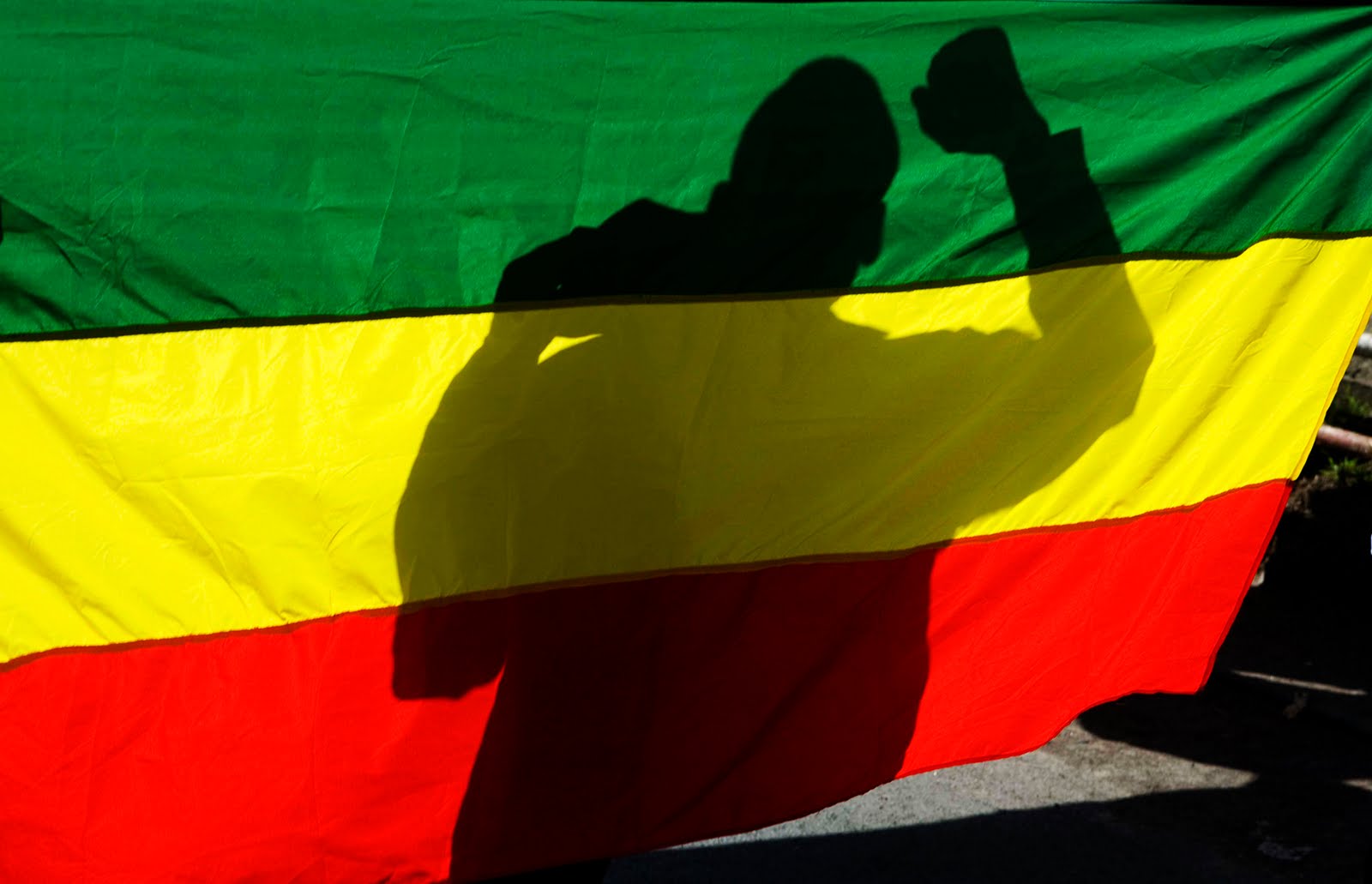
Photo: The shadow of a supporter of Ethiopia’s Unity for Democracy and Justice party (UDJ) is seen through an Ethiopian flag during a demonstration in the capital Addis Ababa, April 16, 2009. REUTERS/Irada Humbatova
______________________________
The Arab Spring’s effects continue to ripple outward. As Tahrir Square fills once more, it gains new momentum. For months now, the autocrats of Africa have feared it would move south, infecting their youth in often-unemployed, restless areas.
That fear has come to the ancient civilization of Ethiopia, the second-most populous state (after Nigeria) in Africa. There, since June, the government of Prime Minister Meles Zenawi has cracked down hard on dissidents, opposition groups and, above all, journalists, imprisoning some and forcing others into exile.
The latest refugee is Dawit Kebede, managing editor of one of the few remaining independent papers, the Awramba Times. Kebede, who won an award for freedom from the US-based Committee to Protect Journalists last year, fled to the U.S. last month after he received a tip off that he was about to be arrested.
Also in the past month, apparently reliable reports have circulated of a teacher in his late twenties, Yenesew Gebre, who burnt himself alive in protest against political repression in his home town of Dawra, in the south of the country. It has also been reported, by sources who spoke to the opposition satellite station, ESAT, based in the US, that Gebre had been dismissed from his teaching post because of his political views.
The move recalls the self-immolation of Mohamed Bouazizi – another young man in his twenties – in Sidi Bouzid, Tunisia in January this year, a catalyst for the protests there and elsewhere in the spring. The parallel is being widely made in oppositionist sites and media.
One of the oppositionists in exile is a journalist who, with others, founded a newspaper in October 2007, named Addis Neger. It was tolerated for two years, then closed down in December 2009. The founders, fearing arrest, left the country: Abiye Teklemariam came to the UK, where I spoke with him.
“The self immolation of Yenesew Gebre is an extraordinary thing,” he said. “The more so since it’s absolutely not in the tradition of Ethiopia to take one’s own life like this. It is an expression of how far people are prepared to go, how frustrated they are. Part of the problem is that the foreign states who give aid – like the United States and the United Kingdom – don’t seem to care. The government now says that because it has strong growth, civil rights must suffer. And the foreign donors have accepted that: so there is no pressure on the regime.”
Ethiopia isn’t, for the most part, like the Arab states who rose in different kind of revolts this past year. It’s bigger than most – with a population of some 82 million it’s slightly bigger than Egypt – and though still poor, it’s been growing strongly in the past decade. It also has a parliament with elections and opposition parties, which have had seats in the parliament.
In the 2005 elections, the opposition groups won about one third of the parliament’s 546 seats. After that, however, oppositionists say there was a massive crackdown on the opposition, who engaged in widespread protests against what they saw as rigged elections. Some 200 people died in these protests, mostly at the hands of the security forces.
Among the biggest political victims of the crackdown was Dr. Berhanu Nega, an academic and businessman, who was elected mayor of the capital, Addis Ababa, and whose party, the Coalition for Unity and Democracy, achieved just under 20 percent of the vote in the national election. With other leaders of his party, he was imprisoned, released in 2007 and fled to the US. There he has created an opposition party in exile, Ginbot 7, which calls for a revolutionary overthrow of the government of Prime Minister Zenawi, who has led the country since August 1995.
In the last elections, in May 2010, the government claimed over 99 percent of the parliamentary seats for its main party, the Peoples Revolutionary Democratic Front, and its allies. Zenawi, in a public address after the poll, said any repeat of the 2005 protests would not be tolerated. Ginbot 7, and other oppositionist groups, have been labeled as terrorists: Nega has been sentenced to death in absentia.
The Ethiopian government was asked, through its embassy in London, for a response to charges of repression, but they declined to comment.
I called Ephraim Madebo, spokesman for Ginbot 7, who is based in New York, to ask him if there was any possibility of a rapprochement between the many oppositionist groups and the government, so that open elections might take place. He said that “there is no chance whatsoever. They are using laws, especially the media law and the anti-terrorist law introduced after 2005 to put their enemies in jail or drive them to exile. You cannot win democratically against the government. People must rise against it. And the government knows something is coming. They just don’t know when”.
One of the outstanding opponents of the regime is Eskinder Nega (no relation to Dr. Nega), a US-educated journalist and newspaper publisher, who was imprisoned with his wife after the 2005 elections. His wife gave birth to his son in prison, though she and the child were later released. Eskinder, however, remains in prison. According to Madebo in New York, he has issued calls for Ethiopians to “fight like the people have done in Egypt, in Tunisia, in Libya”.
In London, Teklemariam has also been labeled as a terrorist – though unlike Ginbot 7, he opposes any use of violence against the regime – and he has been told that Ethiopia will ask the UK to extradite him (the two countries have no extradition treaty, so that is unlikely to happen). He’s less optimistic than Madebo: he says that “the space for collective action is very limited – even though it is growing, if slowly.”
Teklemariam thinks that, as in the Arab states, the internet and the social media networks are crucial to the development of a widespread movement – but Ethiopia lacks both. The net is largely confined to the capital, and social media users are few: in large part, he says, because the government ensures that connections are very slow and often dysfunctional.
The Ethiopian elite is small and badly served by communication, but Teklemariam says that “it really matters in Ethiopia. So the government has to make it hard for them to communicate. There was very little access to news about the Arab Spring.”
You can see why some African governments want to suppress news of the revolts in the north. Their transplantation south, and their even partial success, means loss of power, loss of wealth – or even, if it comes to outright conflict, loss of life (the jerky videos of the last minutes of Gadaffi’s life are a hideous toxin for all autocrats). Ethiopia’s rulers have sought a prophylactic against such radicalism in preventative arrests, seeking to neutralize all those who might lead or give shape to dissent.
But Gaddaffi’s end spells a lesson other than suppression. It is to allow and encourage the growth of democratic habits and freer speech. For one of the few hopeful signs in this doom-laden world is that suppression now works badly, for shorter periods, and that a democratic opening may find men and women willing to make it work. As we enter winter, spring may come again.
______________________________
Photo: The shadow of a supporter of Ethiopia’s Unity for Democracy and Justice party (UDJ) is seen through an Ethiopian flag during a demonstration in the capital Addis Ababa, April 16, 2009. REUTERS/Irada Humbatova
______________________________
Thursday, December 8, 2011
Ethiopian Court Mulls Journalists' Role in Conflict Zones
By Peter Heinlein, VOA
The trial of two Swedish journalists charged with supporting terrorism in Ethiopia has ended with a discussion of the role of reporters in conflict zones.
The defense wrapped up its case by calling two veteran foreign correspondents as witnesses.
A three-judge Ethiopian federal court panel is to hand down a verdict December 21 in the case of freelance journalists Martin Schibbye and Johan Persson. The pair are charged with offering support to the Ogaden National Liberation Front (ONLF), a rebel group Ethiopia has labeled a terrorist organization.
Schibbye and Persson were arrested June 30 in the company of ONLF fighters, after a gunbattle between the rebels and Ethiopian troops, who are engaged in a counter-insurgency operation in the region. A video recorded a day after the clash and played in court Wednesday shows the two men wearing bandages from minor wounds suffered in the exchange of fire.
ONLF communiques sent by email tell of frequent clashes in the mostly Muslim region, which borders Somalia. The claims cannot be independently confirmed because the region is off-limits to most outsiders, but government officials have described the reports as “exaggerated."
The case of the two Swedes gained notoriety after Ethiopian Prime Minister Meles Zenawi publicly commented on the charges against them. In an interview with a Norwegian newspaper, Meles said they were “at the least messenger boys for a terrorist organization."
At the trial, Schibbye and Persson admitted illegally crossing the border from Somalia into Ethiopia, but denied supporting the ONLF. They said they were in the Ogaden to investigate the activities of a Swedish oil firm with interests in the region.
As they closed their case Wednesday, defense attorneys called two veteran foreign correspondents to testify about how journalists operate in conflict zones.
Adrian Blomfield, the Middle East correspondent for the London Daily Telegraph, said reporters must sometimes travel to off-limits areas and meet what some would call unsavory characters in search of stories that governments would prefer are not told. He summarized his testimony for VOA.
"People who have reported in conflict zones often for various reasons may cross a border unofficially or with a particular group, and I just wanted to get across the point there is nothing untoward, there is nothing sinister about this. This is just how journalists operate, and sometimes we get caught, but we don't expect to be charged with terrorism as a result," said Blomfield.
Blomfield said he explained to the court that what Schibbye and Persson did is standard procedure for reporters covering conflicts.
"This is not an unusual case. This is what journalists do all over the world for whatever reasons," said Blomfield.
Schibbye and Persson were charged under a recently enacted anti-terrorism law criticized as “overly vague” by human rights and press freedom groups. The statute criminalizes any reporting deemed to encourage or provide moral support to groups that the government considers terrorists.
If convicted, the two Swedes could face up to 15 years in prison.
Sweden's ambassador to Ethiopia, Jens Odlander, told reporters after the trial the Stockholm government remains steadfast in its contention that Schibbye and Persson are bona fide journalists. He expressed optimism for a favorable verdict.
"I'm expecting a good outcome. I don't want to elaborate too much on it, but I expect a very good outcome from this," said Odlander.
Attorneys say final arguments in the case are to be submitted in writing within the week. The court is scheduled to hand down its verdict in the final 10 days of the year.
The trial of two Swedish journalists charged with supporting terrorism in Ethiopia has ended with a discussion of the role of reporters in conflict zones.
The defense wrapped up its case by calling two veteran foreign correspondents as witnesses.
A three-judge Ethiopian federal court panel is to hand down a verdict December 21 in the case of freelance journalists Martin Schibbye and Johan Persson. The pair are charged with offering support to the Ogaden National Liberation Front (ONLF), a rebel group Ethiopia has labeled a terrorist organization.
Schibbye and Persson were arrested June 30 in the company of ONLF fighters, after a gunbattle between the rebels and Ethiopian troops, who are engaged in a counter-insurgency operation in the region. A video recorded a day after the clash and played in court Wednesday shows the two men wearing bandages from minor wounds suffered in the exchange of fire.
ONLF communiques sent by email tell of frequent clashes in the mostly Muslim region, which borders Somalia. The claims cannot be independently confirmed because the region is off-limits to most outsiders, but government officials have described the reports as “exaggerated."
The case of the two Swedes gained notoriety after Ethiopian Prime Minister Meles Zenawi publicly commented on the charges against them. In an interview with a Norwegian newspaper, Meles said they were “at the least messenger boys for a terrorist organization."
At the trial, Schibbye and Persson admitted illegally crossing the border from Somalia into Ethiopia, but denied supporting the ONLF. They said they were in the Ogaden to investigate the activities of a Swedish oil firm with interests in the region.
As they closed their case Wednesday, defense attorneys called two veteran foreign correspondents to testify about how journalists operate in conflict zones.
Adrian Blomfield, the Middle East correspondent for the London Daily Telegraph, said reporters must sometimes travel to off-limits areas and meet what some would call unsavory characters in search of stories that governments would prefer are not told. He summarized his testimony for VOA.
"People who have reported in conflict zones often for various reasons may cross a border unofficially or with a particular group, and I just wanted to get across the point there is nothing untoward, there is nothing sinister about this. This is just how journalists operate, and sometimes we get caught, but we don't expect to be charged with terrorism as a result," said Blomfield.
Blomfield said he explained to the court that what Schibbye and Persson did is standard procedure for reporters covering conflicts.
"This is not an unusual case. This is what journalists do all over the world for whatever reasons," said Blomfield.
Schibbye and Persson were charged under a recently enacted anti-terrorism law criticized as “overly vague” by human rights and press freedom groups. The statute criminalizes any reporting deemed to encourage or provide moral support to groups that the government considers terrorists.
If convicted, the two Swedes could face up to 15 years in prison.
Sweden's ambassador to Ethiopia, Jens Odlander, told reporters after the trial the Stockholm government remains steadfast in its contention that Schibbye and Persson are bona fide journalists. He expressed optimism for a favorable verdict.
"I'm expecting a good outcome. I don't want to elaborate too much on it, but I expect a very good outcome from this," said Odlander.
Attorneys say final arguments in the case are to be submitted in writing within the week. The court is scheduled to hand down its verdict in the final 10 days of the year.
Intimidation or imprisonment by 'democratic instruments'
By Mesfin Negash/CPJ Guest Blogger
Three years ago, I met Minister Bereket Simon at his office at the center of Addis Ababa. I was with my colleague Abiye Teklemariam -- who was recently charged with terrorism, treason and espionage along with five other journalists, including myself.
Our purpose in meeting Bereket was to make our position clear regarding the government's wasteful animosity toward us, and express our concerns surrounding press freedom in Ethiopia. The period was a tense and confrontational one for staff members of our newspaper, Addis Neger. Many observers had begun to predict the imminentclosure of Addis Neger and our inevitable arrest. As became evident later, the government was suspicious of us and had already decided our fate. Of what were they suspicious? That depends on whether you want the public version of their suspicion, or the other version, relating to politics and power. The public version is a cover up for the latter version.
The biggest worry for any autocrat stems from individuals and institutions that appear to be independent and attractive to one or more sections of society. The Ethiopian government's real suspicion -- more appropriate to call it fear -- was that Addis Neger or people gathering around its ideals could be turned into a political force. This may have taken different forms, the government assumed -- including forming a new political party as a solid group; joining one of the oppositions; endorsing or actively supporting opposition parties; or challenging the legitimacy of the regime by forming critical opinions.
No intelligent leader can declare this panic in public. The creative capacity of any autocrat reveals itself in his ability to formulate a public suspicion that can conceal the primary concern, which is to stay in power.
Bereket is the right-hand man of Ethiopian Prime Minister Meles Zenawi, and has handled the government's media affairs for 20 years. In our meeting with him, we highlighted the public's fear of a sudden and blanket closure of independent newspapers, as had happened in 2005. Bereket was articulate in addressing our concern: "Have no worry about that; we won't repeat that kind of measure. Instead, the government is determined to handle both the media and journalists using democratic instruments."
By "democratic instruments," Bereket meant lawsand government organs - each being an appendix of the ruling party. Instead of closing a newspaper by ordering the printing house not to print, the law made the printer responsible for the content of what he is printing. Instead of telling reporters to stop writing about a particular political group or view, such reporting is criminalized by the outlawing of the party (as well as any discussion regarding its view). The government no more issues an order to arrest activists or close an independent NGO working to empower citizens or expose human rights abuses. It simply makes life impossible for such groups by requiring them by law to cover 90% of their budget from local sources.
Thus, the public suspicion is aimed at sensitizing the public, or at least ruling party members, about the legal action the government is going to take using "democratic instruments." It is often based on fabricated or half-baked conspiracy plots. Some of the allegations against independent newspapers and journalists in Ethiopia paint them as dangerous elements posing a threat to the country: the agents of foreign forces or enemy states; operatives of the CIA; members or supporters of opposition or extremist groups; advocates of anti-ethnic or religious groups; advocates of anti-state ideas, and more.
Such allegations are used the world over to silence and intimidate independent voices. Such instruments are used to jail journalists, not just by the Ethiopian government but also by the worst offenders, the governments of Iran and China.
When my colleague Abiye and I met with Bereket, we were bold enough to explain our fundamental positions as an independent media institution and responsible journalists. He was also honest enough to admit the government's fear, saying, "You have a political agenda." What does this mean, where anything from an editorial to a cartoon can be considered political and entail an agenda?
Today, my colleague, journalist and blogger Eskinder Nega, has been imprisoned since September 14 in Maekelawi Federal Detention Center. Note that the government is holding him using a "democratic instrument" called the "Anti-Terrorism Law." The same instrument put journalists Woubshet Taye and Re'eyot Alemu behind bars. The two Swedish journalists, Johan Persson and Martin Schibbye, are also in prison defending their professional activities, which are criminalizedin Ethiopia..
Three years ago, I met Minister Bereket Simon at his office at the center of Addis Ababa. I was with my colleague Abiye Teklemariam -- who was recently charged with terrorism, treason and espionage along with five other journalists, including myself.
The biggest worry for any autocrat stems from individuals and institutions that appear to be independent and attractive to one or more sections of society. The Ethiopian government's real suspicion -- more appropriate to call it fear -- was that Addis Neger or people gathering around its ideals could be turned into a political force. This may have taken different forms, the government assumed -- including forming a new political party as a solid group; joining one of the oppositions; endorsing or actively supporting opposition parties; or challenging the legitimacy of the regime by forming critical opinions.
No intelligent leader can declare this panic in public. The creative capacity of any autocrat reveals itself in his ability to formulate a public suspicion that can conceal the primary concern, which is to stay in power.
Bereket is the right-hand man of Ethiopian Prime Minister Meles Zenawi, and has handled the government's media affairs for 20 years. In our meeting with him, we highlighted the public's fear of a sudden and blanket closure of independent newspapers, as had happened in 2005. Bereket was articulate in addressing our concern: "Have no worry about that; we won't repeat that kind of measure. Instead, the government is determined to handle both the media and journalists using democratic instruments."
By "democratic instruments," Bereket meant lawsand government organs - each being an appendix of the ruling party. Instead of closing a newspaper by ordering the printing house not to print, the law made the printer responsible for the content of what he is printing. Instead of telling reporters to stop writing about a particular political group or view, such reporting is criminalized by the outlawing of the party (as well as any discussion regarding its view). The government no more issues an order to arrest activists or close an independent NGO working to empower citizens or expose human rights abuses. It simply makes life impossible for such groups by requiring them by law to cover 90% of their budget from local sources.
Thus, the public suspicion is aimed at sensitizing the public, or at least ruling party members, about the legal action the government is going to take using "democratic instruments." It is often based on fabricated or half-baked conspiracy plots. Some of the allegations against independent newspapers and journalists in Ethiopia paint them as dangerous elements posing a threat to the country: the agents of foreign forces or enemy states; operatives of the CIA; members or supporters of opposition or extremist groups; advocates of anti-ethnic or religious groups; advocates of anti-state ideas, and more.
Such allegations are used the world over to silence and intimidate independent voices. Such instruments are used to jail journalists, not just by the Ethiopian government but also by the worst offenders, the governments of Iran and China.
When my colleague Abiye and I met with Bereket, we were bold enough to explain our fundamental positions as an independent media institution and responsible journalists. He was also honest enough to admit the government's fear, saying, "You have a political agenda." What does this mean, where anything from an editorial to a cartoon can be considered political and entail an agenda?
Today, my colleague, journalist and blogger Eskinder Nega, has been imprisoned since September 14 in Maekelawi Federal Detention Center. Note that the government is holding him using a "democratic instrument" called the "Anti-Terrorism Law." The same instrument put journalists Woubshet Taye and Re'eyot Alemu behind bars. The two Swedish journalists, Johan Persson and Martin Schibbye, are also in prison defending their professional activities, which are criminalizedin Ethiopia..
Wednesday, December 7, 2011
The journalist as terrorist: an Ethiopian story
By
I couldn't say that nothing prepared me for the morning of 8 November 2011. Over the past year, Ethiopians have become accustomed to our country's prime minister's ex-cathedra declarations that most of his opponents and dissidents are "terrorists" who belong in prison - and are saved from only by his benignity and patience. Meles Zenawi's declarations, to be fair to him, were also given a legal basis in 2009, when the Ethiopian parliament passed a law that criminalises almost all acts of dissent as terrorism. If that law had been implemented to its fullest extent, no critic of Zenawi would have been left standing. It is that stifling.
But even Zenawi's kindness has its limits. Since June 2011, terrorism trials have increased steadily. Human Rights Watch reports that in these five months, the Ethiopian government has charged at least thirty-three people under the 2009 proclamation. Even during the Ethiopian new year, which falls in September, Ethiopian dissidents were given no respite from these attacks.
The world barely noticed these politico-criminal dramas in one of the west's closest African allies - until the unfortunate arrest and trial of two Swedish journalists. Good news? Well, a useful rule of thumb is that if the Ethiopian government treats foreigners from donor countries badly, it treats locals even worse. And the calculated anti-west outbursts of Ethiopian officials, which are usually interpreted by some hapless foreign journalists and diplomats in Addis Ababa as a general hostility to westerners, are less than they seem: reminiscent of Hamid Karzai's grandstanding. To paraphrase the senior United States military commander Peter Fuller, who resigned following his criticism of Afghan leaders, Ethiopian officials have a fit when they want to replace cod with swordfish in the menu.
But with all this in mind, the charges were still upsetting. They allege, first, that I have promoted the views of diverse Ethiopian "terrorist groups", both on the online newspaper I co-founded and on some (unnamed) social-media networks. In fact, these groups have only one thing in common, namely the overthrow of Meles Zenawi's rule and the establishment of a democratic system in Ethiopia. My "promotion" of them in various reports consisted in nothing more than quoting their statements: the sort of thing that journalists do every day, and for which many journalists in Ethiopia are already in jail.
The second, graver, charge alleges that I am a member of a conspiracy network that has caused or tried to cause acts of terrorism in Ethiopia with the help of foreign governments. So bereft of details is the accusation that it might as well have been copied from a Muammar Gaddafi speech. Indeed, to the misfortune of his victims, Zenawi shares with Gaddafi (at least in the penultimate phase of the latter's career) the experience of being feted by many of these foreign governments as a transformative leader and worthy ally.
Behind the image
Meles Zenawi’s greatest trick has been to convince a lot of people in the west that he is an intelligent and prudent leader. The basis for such an image is ever-shifting. In the 1990s, it was based on his ability to stabilise a war-ravaged country. When the Ethiopia-Eritrea war undermined his claim to be a peacemaker, he adopted the guise of a pro-western and pro-democracy reformer, advising Tony Blair on how to nurture civil society and free media in Africa and using Bushisms such as "enemy of freedom" to attack "jihadists". During the Iraq war, he quickly joined the "coalition of the willing". Yet his status among some prominent members of the anti-war intelligentsia was unaffected; leading American economists Joseph Stiglitz, Jeffrey Sachs and Dani Rodrik were among the regular travellers to Addis Ababa.
It took the controversial elections of 2005, and the brutal crackdown of dissent that followed, to begin to erode the illusion of Meles Zenawi's democratic credentials. Yet even from the ashes of that debacle a new image emerged: of the leader as a technocratic, if dictatorial, leader who had been able to crack the code of east Asia's rise and download it into an Ethiopian hardware. This latest identity cohered well with the emerging discourse about the gap between responsible and responsive government, and the paralysis of decision-making in democracies. It was also fuelled by the World Bank’s unquestioning endorsement - against the well-founded scepticism of some economists - of Ethiopia's official, spectacular growth numbers. There is not even a single independent institution in Ethiopia able to assess and verify the government's claims.
It is not difficult to comprehend why many intellectuals and policymakers in the west find Meles Zenawi alluring. He is an articulate and fluent man known to to read the books of scholars he is about to meet and convey the impression that he finds their work profound. This eloquent mirroring of the ideas of visitors, including wonkish politicians and policy-makers, is a sure route to the latter's servility. Some of this effect is owed to a contrast made by western observers between Zenawi and other African leaders, which leads to the conclusion that he is "different": the soft bigotry of lowered expectations.
A matter of justice
There is nothing intrinsically deplorable about admiring the intellect of a tyrant. The grievous mistake is to let such a judgment cloud the imperative of evaluating fairly the regime's nature and designing policy on the ground of solid evidence. If the mountain of well-documented reports of international human-rights groups and the experiences of people like me are to be believed, Zenawi’s Ethiopia has become one of the most despotic places in the world. Dissent is criminalised. Most members of the non-state media have either left the country or are locked in the country's abusive prisons. Opposition parties operate in an extremely constrained political space.
The tactics of divide and rule, co-option and repression have eviscerated Ethiopia's social trust, destroyed political institutions and decimated independent voices - and it seems that Zenawi is intent on intensifying such tactics rather than reversing them. The economy is beset by very high inflation, high unemployment and a foreign-exchange crunch; the private sector, dominated by rentier cronies of the prime minister's ruling party, is one of the least competitive and the most stagnant in Africa. There is precious little here that justifies the respect that the architect of this system is internationally accorded.
As I await my extradition hearing, Meles Zenawi continues to hobnob with the world's most powerful politicians in meetings which are organised to solve our planet's major problems. Neither his very long tyrannical rule nor my life as a liberal journalist with an unwavering commitment to justice and non-violent struggle suggests that we deserve our respective places. Real life can indeed be stranger than fiction..
I couldn't say that nothing prepared me for the morning of 8 November 2011. Over the past year, Ethiopians have become accustomed to our country's prime minister's ex-cathedra declarations that most of his opponents and dissidents are "terrorists" who belong in prison - and are saved from only by his benignity and patience. Meles Zenawi's declarations, to be fair to him, were also given a legal basis in 2009, when the Ethiopian parliament passed a law that criminalises almost all acts of dissent as terrorism. If that law had been implemented to its fullest extent, no critic of Zenawi would have been left standing. It is that stifling.
But even Zenawi's kindness has its limits. Since June 2011, terrorism trials have increased steadily. Human Rights Watch reports that in these five months, the Ethiopian government has charged at least thirty-three people under the 2009 proclamation. Even during the Ethiopian new year, which falls in September, Ethiopian dissidents were given no respite from these attacks.
The world barely noticed these politico-criminal dramas in one of the west's closest African allies - until the unfortunate arrest and trial of two Swedish journalists. Good news? Well, a useful rule of thumb is that if the Ethiopian government treats foreigners from donor countries badly, it treats locals even worse. And the calculated anti-west outbursts of Ethiopian officials, which are usually interpreted by some hapless foreign journalists and diplomats in Addis Ababa as a general hostility to westerners, are less than they seem: reminiscent of Hamid Karzai's grandstanding. To paraphrase the senior United States military commander Peter Fuller, who resigned following his criticism of Afghan leaders, Ethiopian officials have a fit when they want to replace cod with swordfish in the menu.
But with all this in mind, the charges were still upsetting. They allege, first, that I have promoted the views of diverse Ethiopian "terrorist groups", both on the online newspaper I co-founded and on some (unnamed) social-media networks. In fact, these groups have only one thing in common, namely the overthrow of Meles Zenawi's rule and the establishment of a democratic system in Ethiopia. My "promotion" of them in various reports consisted in nothing more than quoting their statements: the sort of thing that journalists do every day, and for which many journalists in Ethiopia are already in jail.
The second, graver, charge alleges that I am a member of a conspiracy network that has caused or tried to cause acts of terrorism in Ethiopia with the help of foreign governments. So bereft of details is the accusation that it might as well have been copied from a Muammar Gaddafi speech. Indeed, to the misfortune of his victims, Zenawi shares with Gaddafi (at least in the penultimate phase of the latter's career) the experience of being feted by many of these foreign governments as a transformative leader and worthy ally.
Behind the image
Meles Zenawi’s greatest trick has been to convince a lot of people in the west that he is an intelligent and prudent leader. The basis for such an image is ever-shifting. In the 1990s, it was based on his ability to stabilise a war-ravaged country. When the Ethiopia-Eritrea war undermined his claim to be a peacemaker, he adopted the guise of a pro-western and pro-democracy reformer, advising Tony Blair on how to nurture civil society and free media in Africa and using Bushisms such as "enemy of freedom" to attack "jihadists". During the Iraq war, he quickly joined the "coalition of the willing". Yet his status among some prominent members of the anti-war intelligentsia was unaffected; leading American economists Joseph Stiglitz, Jeffrey Sachs and Dani Rodrik were among the regular travellers to Addis Ababa.
It took the controversial elections of 2005, and the brutal crackdown of dissent that followed, to begin to erode the illusion of Meles Zenawi's democratic credentials. Yet even from the ashes of that debacle a new image emerged: of the leader as a technocratic, if dictatorial, leader who had been able to crack the code of east Asia's rise and download it into an Ethiopian hardware. This latest identity cohered well with the emerging discourse about the gap between responsible and responsive government, and the paralysis of decision-making in democracies. It was also fuelled by the World Bank’s unquestioning endorsement - against the well-founded scepticism of some economists - of Ethiopia's official, spectacular growth numbers. There is not even a single independent institution in Ethiopia able to assess and verify the government's claims.
It is not difficult to comprehend why many intellectuals and policymakers in the west find Meles Zenawi alluring. He is an articulate and fluent man known to to read the books of scholars he is about to meet and convey the impression that he finds their work profound. This eloquent mirroring of the ideas of visitors, including wonkish politicians and policy-makers, is a sure route to the latter's servility. Some of this effect is owed to a contrast made by western observers between Zenawi and other African leaders, which leads to the conclusion that he is "different": the soft bigotry of lowered expectations.
A matter of justice
There is nothing intrinsically deplorable about admiring the intellect of a tyrant. The grievous mistake is to let such a judgment cloud the imperative of evaluating fairly the regime's nature and designing policy on the ground of solid evidence. If the mountain of well-documented reports of international human-rights groups and the experiences of people like me are to be believed, Zenawi’s Ethiopia has become one of the most despotic places in the world. Dissent is criminalised. Most members of the non-state media have either left the country or are locked in the country's abusive prisons. Opposition parties operate in an extremely constrained political space.
The tactics of divide and rule, co-option and repression have eviscerated Ethiopia's social trust, destroyed political institutions and decimated independent voices - and it seems that Zenawi is intent on intensifying such tactics rather than reversing them. The economy is beset by very high inflation, high unemployment and a foreign-exchange crunch; the private sector, dominated by rentier cronies of the prime minister's ruling party, is one of the least competitive and the most stagnant in Africa. There is precious little here that justifies the respect that the architect of this system is internationally accorded.
As I await my extradition hearing, Meles Zenawi continues to hobnob with the world's most powerful politicians in meetings which are organised to solve our planet's major problems. Neither his very long tyrannical rule nor my life as a liberal journalist with an unwavering commitment to justice and non-violent struggle suggests that we deserve our respective places. Real life can indeed be stranger than fiction..
Ethiopian Illicit Outflows Doubled In 2009, New Report Says
By Christopher Matthews
Ethiopia lost $11.7 billion to outflows of ill-gotten gains between 2000 and 2009, according to a coming report by Global Financial Integrity.
That’s a lot of money to lose to corruption for a country that has a per-capita GDP of just $365. In 2009, illicit money leaving the country totaled $3.26 billion, double the amount in each of the two previous years. The capital flight is also disturbing because the country received $829 million in development aid in 2008.
According to GFI economist Sarah Freitas, who co-authored the report, corruption, kickbacks and bribery accounted for the vast majority of the increase in illicit outflows.
“The scope of Ethiopia’s capital flight is so severe that our conservative US$3.26 billion estimate greatly exceeds the US$2 billion value of Ethiopia’s total exports in 2009,” Freitas wrote in a blog post on the website of the Task Force on Financial Integrity and Economic Development.
The report, titled “Illicit Financial Flows from Developing Countries over the Decade Ending 2009,” drew on data from the World Bank and the International Monetary Fund on external debt and trade mis-pricing to calculate illicit capital leakage. The study, which will be released later this month, measures the illicit financial flows out of 160 different developing nations.
Ethiopia is one of the poorest countries on earth as 38.9% of Ethiopians live in poverty, and life expectancy in 2009 was just 58 years.
“The people of Ethiopia are being bled dry,” Freitas wrote. “No matter how hard they try to fight their way out of absolute destitution and poverty, they will be swimming upstream against the current of illicit capital leakage.”
Ethiopia lost $11.7 billion to outflows of ill-gotten gains between 2000 and 2009, according to a coming report by Global Financial Integrity.
That’s a lot of money to lose to corruption for a country that has a per-capita GDP of just $365. In 2009, illicit money leaving the country totaled $3.26 billion, double the amount in each of the two previous years. The capital flight is also disturbing because the country received $829 million in development aid in 2008.
According to GFI economist Sarah Freitas, who co-authored the report, corruption, kickbacks and bribery accounted for the vast majority of the increase in illicit outflows.
“The scope of Ethiopia’s capital flight is so severe that our conservative US$3.26 billion estimate greatly exceeds the US$2 billion value of Ethiopia’s total exports in 2009,” Freitas wrote in a blog post on the website of the Task Force on Financial Integrity and Economic Development.
The report, titled “Illicit Financial Flows from Developing Countries over the Decade Ending 2009,” drew on data from the World Bank and the International Monetary Fund on external debt and trade mis-pricing to calculate illicit capital leakage. The study, which will be released later this month, measures the illicit financial flows out of 160 different developing nations.
Ethiopia is one of the poorest countries on earth as 38.9% of Ethiopians live in poverty, and life expectancy in 2009 was just 58 years.
“The people of Ethiopia are being bled dry,” Freitas wrote. “No matter how hard they try to fight their way out of absolute destitution and poverty, they will be swimming upstream against the current of illicit capital leakage.”
Saturday, December 3, 2011
Mesfin Negash: “We shouldn’t give the dictators what they want, which is our silence at home and abroad.”
By Joseph Edgar- Sampsonia Way

Mesfin Negash calls himself a journalist and refuses to be tagged political, activist, or opponent. Since 2001 he has written and edited in-depth analysis, interviews, features, and essays that have criticized Ethiopia’s government as well as its opposition. In 2007 along with five colleagues, he founded the newspaper Addis Neger (New Affairs), which under his direction grew to be one of Ethiopia’s leading newspapers.
Two years after its opening, Addis Neger, as any other independent media outlet in Ethiopia, faced intimidation and harassment as a consequence of Ethiopia’s anti-terrorism law. This law criminalizes any reporting that directly or indirectly “encourages” or provides “moral support” to “terrorist groups.” It has become the biggest threat for the country’s journalists as the government deems what is “encouraging” and labels what a “terrorist group” is.
Despite the law, Addis Neger maintained its policy of covering all the actors of its society, including the opposition, and scrutinized official documents of the ruling party and policies. That was the tipping point for the government to charge the Addis Neger staff with terrorism and force them into exile. Negash was officially charged by the government for “terrorism, treason, and espionage” in early November with another twenty-three defendants, six of them journalists.
Negash was recommended to Sampsonia Way by the staff of Committee to Protect Journalists. Now living in exile in Sweden, and after several technical problems with Skype, he talked with us about the effect of the anti-terrorism law on Ethiopian journalism, the law’s hand in the exile of Addis Neger’s staff, and denies the validity of the government’s charges against him. Negash also talked about his difficulties living and publishing in exile, and analyzes the Wikileaks cables that exposed his colleague to persecution.
Why did you decide it was time to leave Ethiopia?
Because we, the three founding editors that were still living in the country (Girma Tesfaw, Masresha Mamo and myself), confirmed that the government was preparing to charge us for promoting terrorism and supporting terrorist organizations. The government had a grudge against us and they decided to do something to silence us before the election in May 2010. We had very credible sources within the government and the diplomatic community for this information.
Before we decided to leave, the government tried to take us to court and started a smear campaign against our newspaper so that the public would associate us with so-called “terrorist organizations.” There were a series of articles and programs on government media outlets designed to sensitize the public so that when they finally arrested us it wouldn’t come as a surprise.
Can you give me an example of something that Addis Neger published that the government was not pleased with?
It was a cumulative effect, not a single article, that put us in danger. Addis Neger was more analytical than the other media outlets. We didn’t use the tabloid style of reporting. We wrote in-depth analysis, interviews and so on. Our paper focused on hardcore national issues.
We questioned the constitutionality of the laws approved by parliament that worked to weaken independent voices; the illegitimate, but calculated, confusion between party and government structures; the abuse of government policies and resources for personal and party benefit; the repression of independent political parties, citizen societies, journalists, and human rights activists. We also focused on diplomatic relations, given the fact that Ethiopia has a strategic importance for both the west and the east, including China.
We wrote heavily about the economic impact of these policies and diplomatic relations on the public and the education system. These topics were our main focus, contrary to most Ethiopian papers. We were very honest! We tried to give credit to the government when it performed something positive, but in most cases the articles were very damaging for them.
Even though the newspaper was critical of the ruling party, we were also courageous and balanced enough to give a regular column to one active member of the party. We gave him a full page every week to write whatever he liked, supporting or justifying his party and criticizing the opposition, et cetera. He was a regular contributor since the launch of our paper. Addis Neger was the first independent newspaper to bring in a member of the ruling party as a regular contributor. Because we were committed to have the ruling party’s view for the benefit of our readers, when the first contributor stopped writing we found another party member to write the column.
Another point of focus at Addis Neger was covering the most significant opposition groups at home and abroad. This includes the opposition coalition forum MEDREK and its members, Ginbot 7 and Oromo Liberation Front (OLF), two of the organizations designated as terrorist by the government…
The major political opposition parties in Ethiopia.
Right. The leader of Ginbot 7, Dr. Berhanu Nega, is now in exile in the United States. We wrote a feature about his organization. To the government, we were promoting them, but we hadn’t endorsed them. Actually, we have every right to write whatever we like—it’s normal in any civilized nation for a newspaper to endorse this party or that party on its editorial page. We didn’t do that, we only covered them. We were even critical of Ginbot 7 in some of those editorials. That didn’t protect us from being associated with a “terrorist” organization and the allegations of promoting “terrorists.” The Ogaden National Liberation Front (ONLF) and the OLF were other groups deemed off-limits by the government. We published stories about all of these organizations, but I never considered it a crime.
We also reported on the repression and systematic infiltration of labor unions, professional associations, NGOs, and the indoctrination of students and civil servants—something that was only common in former Soviet Bloc countries. We focused on how the ruling TPLF [Tigrayan Peoples' Liberation Front] manipulates ethnic politics at the cost of Ethiopian nationalism. Of course, we also had a number of very critical articles against the opposition. It is there, anyone can read that.
The other very important topic, which aggravated relations with the government and our newspaper, is that we began to expose the inherent totalitarian nature of the regime. In most cases they wanted to cover it up with rhetoric. We uncovered their old documents—that in most cases are not accessible to the public—to understand how they see Ethiopian politics, society, and history. It was surprising, even for us. It became definitive that the Prime Minister and the cronies around him are not in power to bring democracy to Ethiopia. This became a kind of second-revelation for the opposition later on, and made the government very angry.
Another concern of the government was the symbolic significance of Addis Neger and its staff. Addis Neger created a solid readership among many educated young Ethiopians. The elite from different sections of society became our regular readers, informants, and supporters. We were only one embodiment of the demand for true political reform. There were readers who started regular group discussions inspired by our writings. There were incidents where members of the ruling party questioned their leaders based on what they read in our newspaper. In short, Addis Neger began to inspire people to think, discuss, debate and demand change in different forms. To be honest, this has never been our goal in doing journalism, but I am proud of it. What better gift can you give than inspiration? So the government decided to do something with us.
How you were able to get out of Ethiopia? Who helped you and where did you go? How about your family?
I can only say that I was in Uganda before I came to Sweden because that is already in public domain. I had people facilitate my safe exit from Ethiopia and travel to Uganda. I must keep their names for now. My wife and mother are still in Ethiopia.
How was your stay in Uganda before you ended up in Sweden?
During my stay in Uganda I was imprisoned and harassed by the police. It was no safer for me in Uganda than it was in Ethiopia. Since the July 2010 terrorist attack in Kampala, the situation has become very difficult for Ethiopians. At the time the Ugandans had invited the Ethiopian government into the investigation of that attack and Ethiopian security agents were in full force in Uganda. It became very simple for the Ethiopian forces to arrest, and in some cases torture, Ethiopian refugees in Uganda under the guise of “investigation” and combating “terrorism.”
IGAD [Intergovernmental Authority on Development in the Horn of Africa] had also signed regional conventions on extradition and mutual legal assistance in line with the United Nations’ Global Terrorism Strategy. This means Uganda and Ethiopia now exchange criminals and terrorists. Given Ethiopia’s track record of charging journalists as terrorists, it was very likely that I would be sent back to Ethiopia once I was in Uganda. I was taken in many times and questioned, but none of the questions were about the July terrorist attack. The questions were about whether or not I was working as a journalist in Uganda and who gave me permission to do so. The Ugandan Law of Refugees prohibits refugees from participating in any “political activity” that affects their county of origin. The police told me during the “interrogation” that my activity as a journalist can be considered unlawful and I should stop it or face the consequences. The Ugandan police force is very corrupt and since that second arrest I was repeatedly harassed by police. There was no choice but to give them a bribe so that I didn’t have to spend the night in the police station.
Uganda was not a safe place for me to stay and continue to work as a journalist. I gave notification about these worrisome developments to the United Nations High Commission for refugees and other regulating bodies in Kampala, but they couldn’t help me in any meaningful way. When I had the chance to come to Sweden to attend an international conference on exiled media, I decided to ask for asylum here.
Does Sweden have a system in place for refugees seeking asylum? Is the Swedish community supportive of writers in your position?
So far my asylum case is not yet finalized. I have been waiting for one year. The paradox of the situation is that the Swedish government issued the first statement against the closing of Addis Neger and the editorial staff going into exile, and called for an investigation. The reality, I found after I came here, is disappointing. I cannot apply to bring my family here until my application is approved. They have put me in a remote village far from the nearest city or the capital where many Ethiopians are living. I haven’t found any system here that treats writers, journalists, and human rights activists in any different manner than other refugees. I think greater support from the Swedish community for writers and journalists only happens once you are granted asylum.
However, Swedish chapters of PEN International and RSF wrote letters of support. International and regional organizations such CPJ, HRW, IPI, Front Line, IREX and others also wrote me letters and have given me moral support since I came here.
The authorities here don’t understand the reality in Ethiopia. Either they are indifferent to the plight of Ethiopians or they are deceived by the propaganda, willingly or not. The arrest of two Swedish journalists, rather, shows them a glimpse into the true nature of the Ethiopian government’s regard for journalists and freedom of speech.
Is it possible to publish in Ethiopia while in exile?
We launched our website, www.addisnegeronline.com in May 2010 just before the election in Ethiopia. I am still writing and managing the website along with my colleagues who are in exile all over the world. We are determined not to give what the Ethiopian government wants most from us, which is our silence at home and abroad.
Despite our effort to make it a vibrant media outlet, the website was blocked in Ethiopia, and we have gotten very little support so far. Additionally, the repression at home has a direct bearing on our day-to-day journalistic activity. Our informants at home are afraid because the government is tapping phones and hacking email accounts. This constitutes some of the evidence used to charge the Ethiopian journalists who have been imprisoned recently – we have official reports indicating this.
These days it is very difficult to call someone in Ethiopia and talk freely; they are very afraid! They will say, “We are fine, we are fine. How are you? Ok, goodnight.” You can imagine the effect of these factors on our reporting from exile. We need help so that we can establish a vibrant independent media outlet that will inform Ethiopians and provide anyone abroad with credible information.
As you mentioned, the trial of Swedish journalists Johan Persson and Martin Schibbye began several weeks ago. They were arrested in July and charged with terrorism. They entered Ethiopia illegally through the eastern Ogaden region. Prime Minister Zenawi spoke to a Norwegian newspaper recently, condemning the men as messengers for a terrorist organization. What is your response to the arrest of these men and to Zenawi’s comments?
They entered the country illegally, according to government reports. Entering a country illegally is illegal, no matter the country. The region of Ogaden is closed to all independent journalists, whether they are Ethiopian or not. However, we don’t know which side of the border they were on when they were arrested, whether it was in Somalia or Ethiopia. The journalists admitted that they crossed the border without permit, but it is difficult for me to buy this admission at face value. We must wait for their release to hear their side of the story.
This is another international incident that shows the world the true nature of the Ethiopian regime in Addis Ababa. The regime is manipulating this anti-terrorism mantra to silence dissident voices and reporting.
As for Meles Zenawi’s comment, it is normal for Ethiopians to hear such incriminating comments from him. It is Zenawi who decides the outcome of any politically significant trial in Ethiopia. This was not the first time he has done it, not the last for sure. He is above the courts and rule of law.
Swedish Journalists have rallied to demand the release of their colleagues. Did you participate in that demonstration? Have you been active with the Swedish media in any other way?
I attended the demonstration and added my voice there, demanding their release. I also worked with electronic and print journalists, explaining the reality on the ground in Ethiopia and the possible scenarios involving the fates of Persson and Schibbye.
In June, Woubeshet Taye, the deputy editor of the Amharic-language weekly Awramba Times, and Reyot Alemu, a reporter for the Amharic-language weekly Fitih, were arrested and tried under the anti-terrorism law. Eskinder Neger and Sileshi Hagos were arrested in September. Others were held: Haileyesus Worku, the editor of the state-owned Ethiopian Radio and Television Agency and one of his reporters, Abdulsemed Mohammed, were just released after being held for fifteen months. How can an Ethiopian reporter cover the activities of Ethiopia’s leading opposition figure, Berhanu Nega, or an attack by the ONLF rebels without risking prosecution and imprisonment?
I’d like to explain the intonation of the articles and the anti-terrorism law, regarding freedom of speech. In addition to the official mantra of controlling and preventing terrorism, another sub-text of this anti-terrorism law is silencing dissenting views.
By criminalizing opposition groups, they are also criminalizing any exchange of ideas about these groups. It is a double trap. On the one hand they are criminalizing being a member of said groups and their existence; on the other hand, you can’t even discuss what these organizations stand for, whether their political strategy is bad or not. This is one of the instruments that the government is using to control the flow of information within the country. If an Ethiopian reporter writes about Ginbot 7, OLF, ONLF, or its leaders, he is intentionally taking the risk of being associated with these organizations.
These are Cold War Communist tactics or tactics similar to those used by North Korea. They want to have full control over what the public hears and sees, and ultimately thinks. This is not limited to the media. The government, for example, distributed a guideline for public theaters to influence the content of their plays. The guideline specifically outlines what issues the plays should focus on. We published a feature story regarding this typically communist strategy.
We hear how Gaddafi was a dictator, how Mugabe is a dictator. The Ethiopian regime, in some instances, is worse than them! However, the Ethiopian dictator has one unique quality: He knows what the international community wants to hear and he uses their language. Furthermore, he must be pleased to have a stateless Somalia next door, as the West has become dependent on him to wage the so called “war on terrorism.” They close their eyes to everything happening on the ground.
In September a colleague of yours, Argaw Arshine, fled Ethiopia after Wikileaks released a 2009 U.S. Embassy post that indicated him and an unnamed government official of providing information to the staff at your paper. This incident is what propelled you to close Addis Neger and leave Ethiopia. Have you had contact with him since he left Ethiopia and if so, where is he now?
I do have information about Arshines’ present condition, but I must keep it to myself. It is complicated.
When this information was released Arshine was repeatedly interrogated and forced by police to name his contact in the government. The government claims that questioning of this kind is illegal and he had no reason to flee, but clearly he felt some imminent threat or he wouldn’t have left the country. Is he safe?
He is very safe in an undisclosed location. While still in Ethiopia, he was summoned by the commander of the federal police and was given twenty-four hours to release the name of his government informant. If he had released that person’s name, that person would be in great danger. The government would be very harsh on them to teach a lesson to other potential whistle blowers.
If Arshine had stayed in Ethiopia and refused to give the name, he would have been charged with spying on the government, which is a sentence of potentially ten years or more, not to mention the possibility of being tortured.
Wikileaks has gone on the defense and feigned responsibility for leaking Argaw Ashine’s name. They want the focus to be put back on the repressive Zenawi regime. This has spurred a debate about Wikileaks’ responsibility versus people’s right to information and government transparency. Do you think Wikileaks should be held accountable for failing to protect the names of individuals?
I believe both sides should take their share of the responsibility. The regime in Ethiopia wants to control every source of information. What matters for the government is not whether the report is true or not, but who leaked it.
Wikileaks wants to transfer the blame to The Guardian or the nature of the regime in Ethiopia. No, not at all! One can argue that, in this case, Ashine was acting as a whistle blower, not as a journalist. Therefore Wikileaks is exposing whistle blowers, which is very dangerous; it’s very easy to prosecute whistle blowers in many countries. Thus it is very regrettable that Wikileaks published the cable without editing Ashine’s name. He left his family, his life, his career in Ethiopia and had to start over from zero. He didn’t even have enough time to prepare. After Wikileaks published the cables, Ashine had to be out of the country within a week. After two days he was summoned by the federal police, interrogated, and given an ultimatum. I wonder how the people at Wikileaks can excuse themselves so easily.
We are hoping for a positive outcome for you and your family, and the continuation of your writing.
Thank you. As I said before, we shouldn’t give the dictators what they want, which is our silence whether at home or abroad. Therefore, I will continue writing and inspiring people as much as possible.

Mesfin Negash calls himself a journalist and refuses to be tagged political, activist, or opponent. Since 2001 he has written and edited in-depth analysis, interviews, features, and essays that have criticized Ethiopia’s government as well as its opposition. In 2007 along with five colleagues, he founded the newspaper Addis Neger (New Affairs), which under his direction grew to be one of Ethiopia’s leading newspapers.
Two years after its opening, Addis Neger, as any other independent media outlet in Ethiopia, faced intimidation and harassment as a consequence of Ethiopia’s anti-terrorism law. This law criminalizes any reporting that directly or indirectly “encourages” or provides “moral support” to “terrorist groups.” It has become the biggest threat for the country’s journalists as the government deems what is “encouraging” and labels what a “terrorist group” is.
Despite the law, Addis Neger maintained its policy of covering all the actors of its society, including the opposition, and scrutinized official documents of the ruling party and policies. That was the tipping point for the government to charge the Addis Neger staff with terrorism and force them into exile. Negash was officially charged by the government for “terrorism, treason, and espionage” in early November with another twenty-three defendants, six of them journalists.
Negash was recommended to Sampsonia Way by the staff of Committee to Protect Journalists. Now living in exile in Sweden, and after several technical problems with Skype, he talked with us about the effect of the anti-terrorism law on Ethiopian journalism, the law’s hand in the exile of Addis Neger’s staff, and denies the validity of the government’s charges against him. Negash also talked about his difficulties living and publishing in exile, and analyzes the Wikileaks cables that exposed his colleague to persecution.
Why did you decide it was time to leave Ethiopia?
Because we, the three founding editors that were still living in the country (Girma Tesfaw, Masresha Mamo and myself), confirmed that the government was preparing to charge us for promoting terrorism and supporting terrorist organizations. The government had a grudge against us and they decided to do something to silence us before the election in May 2010. We had very credible sources within the government and the diplomatic community for this information.
Before we decided to leave, the government tried to take us to court and started a smear campaign against our newspaper so that the public would associate us with so-called “terrorist organizations.” There were a series of articles and programs on government media outlets designed to sensitize the public so that when they finally arrested us it wouldn’t come as a surprise.
Can you give me an example of something that Addis Neger published that the government was not pleased with?
It was a cumulative effect, not a single article, that put us in danger. Addis Neger was more analytical than the other media outlets. We didn’t use the tabloid style of reporting. We wrote in-depth analysis, interviews and so on. Our paper focused on hardcore national issues.
We questioned the constitutionality of the laws approved by parliament that worked to weaken independent voices; the illegitimate, but calculated, confusion between party and government structures; the abuse of government policies and resources for personal and party benefit; the repression of independent political parties, citizen societies, journalists, and human rights activists. We also focused on diplomatic relations, given the fact that Ethiopia has a strategic importance for both the west and the east, including China.
We wrote heavily about the economic impact of these policies and diplomatic relations on the public and the education system. These topics were our main focus, contrary to most Ethiopian papers. We were very honest! We tried to give credit to the government when it performed something positive, but in most cases the articles were very damaging for them.
Even though the newspaper was critical of the ruling party, we were also courageous and balanced enough to give a regular column to one active member of the party. We gave him a full page every week to write whatever he liked, supporting or justifying his party and criticizing the opposition, et cetera. He was a regular contributor since the launch of our paper. Addis Neger was the first independent newspaper to bring in a member of the ruling party as a regular contributor. Because we were committed to have the ruling party’s view for the benefit of our readers, when the first contributor stopped writing we found another party member to write the column.
Another point of focus at Addis Neger was covering the most significant opposition groups at home and abroad. This includes the opposition coalition forum MEDREK and its members, Ginbot 7 and Oromo Liberation Front (OLF), two of the organizations designated as terrorist by the government…
The major political opposition parties in Ethiopia.
Right. The leader of Ginbot 7, Dr. Berhanu Nega, is now in exile in the United States. We wrote a feature about his organization. To the government, we were promoting them, but we hadn’t endorsed them. Actually, we have every right to write whatever we like—it’s normal in any civilized nation for a newspaper to endorse this party or that party on its editorial page. We didn’t do that, we only covered them. We were even critical of Ginbot 7 in some of those editorials. That didn’t protect us from being associated with a “terrorist” organization and the allegations of promoting “terrorists.” The Ogaden National Liberation Front (ONLF) and the OLF were other groups deemed off-limits by the government. We published stories about all of these organizations, but I never considered it a crime.
We also reported on the repression and systematic infiltration of labor unions, professional associations, NGOs, and the indoctrination of students and civil servants—something that was only common in former Soviet Bloc countries. We focused on how the ruling TPLF [Tigrayan Peoples' Liberation Front] manipulates ethnic politics at the cost of Ethiopian nationalism. Of course, we also had a number of very critical articles against the opposition. It is there, anyone can read that.
The other very important topic, which aggravated relations with the government and our newspaper, is that we began to expose the inherent totalitarian nature of the regime. In most cases they wanted to cover it up with rhetoric. We uncovered their old documents—that in most cases are not accessible to the public—to understand how they see Ethiopian politics, society, and history. It was surprising, even for us. It became definitive that the Prime Minister and the cronies around him are not in power to bring democracy to Ethiopia. This became a kind of second-revelation for the opposition later on, and made the government very angry.
Another concern of the government was the symbolic significance of Addis Neger and its staff. Addis Neger created a solid readership among many educated young Ethiopians. The elite from different sections of society became our regular readers, informants, and supporters. We were only one embodiment of the demand for true political reform. There were readers who started regular group discussions inspired by our writings. There were incidents where members of the ruling party questioned their leaders based on what they read in our newspaper. In short, Addis Neger began to inspire people to think, discuss, debate and demand change in different forms. To be honest, this has never been our goal in doing journalism, but I am proud of it. What better gift can you give than inspiration? So the government decided to do something with us.
How you were able to get out of Ethiopia? Who helped you and where did you go? How about your family?
I can only say that I was in Uganda before I came to Sweden because that is already in public domain. I had people facilitate my safe exit from Ethiopia and travel to Uganda. I must keep their names for now. My wife and mother are still in Ethiopia.
How was your stay in Uganda before you ended up in Sweden?
During my stay in Uganda I was imprisoned and harassed by the police. It was no safer for me in Uganda than it was in Ethiopia. Since the July 2010 terrorist attack in Kampala, the situation has become very difficult for Ethiopians. At the time the Ugandans had invited the Ethiopian government into the investigation of that attack and Ethiopian security agents were in full force in Uganda. It became very simple for the Ethiopian forces to arrest, and in some cases torture, Ethiopian refugees in Uganda under the guise of “investigation” and combating “terrorism.”
IGAD [Intergovernmental Authority on Development in the Horn of Africa] had also signed regional conventions on extradition and mutual legal assistance in line with the United Nations’ Global Terrorism Strategy. This means Uganda and Ethiopia now exchange criminals and terrorists. Given Ethiopia’s track record of charging journalists as terrorists, it was very likely that I would be sent back to Ethiopia once I was in Uganda. I was taken in many times and questioned, but none of the questions were about the July terrorist attack. The questions were about whether or not I was working as a journalist in Uganda and who gave me permission to do so. The Ugandan Law of Refugees prohibits refugees from participating in any “political activity” that affects their county of origin. The police told me during the “interrogation” that my activity as a journalist can be considered unlawful and I should stop it or face the consequences. The Ugandan police force is very corrupt and since that second arrest I was repeatedly harassed by police. There was no choice but to give them a bribe so that I didn’t have to spend the night in the police station.
Uganda was not a safe place for me to stay and continue to work as a journalist. I gave notification about these worrisome developments to the United Nations High Commission for refugees and other regulating bodies in Kampala, but they couldn’t help me in any meaningful way. When I had the chance to come to Sweden to attend an international conference on exiled media, I decided to ask for asylum here.
Does Sweden have a system in place for refugees seeking asylum? Is the Swedish community supportive of writers in your position?
So far my asylum case is not yet finalized. I have been waiting for one year. The paradox of the situation is that the Swedish government issued the first statement against the closing of Addis Neger and the editorial staff going into exile, and called for an investigation. The reality, I found after I came here, is disappointing. I cannot apply to bring my family here until my application is approved. They have put me in a remote village far from the nearest city or the capital where many Ethiopians are living. I haven’t found any system here that treats writers, journalists, and human rights activists in any different manner than other refugees. I think greater support from the Swedish community for writers and journalists only happens once you are granted asylum.
However, Swedish chapters of PEN International and RSF wrote letters of support. International and regional organizations such CPJ, HRW, IPI, Front Line, IREX and others also wrote me letters and have given me moral support since I came here.
The authorities here don’t understand the reality in Ethiopia. Either they are indifferent to the plight of Ethiopians or they are deceived by the propaganda, willingly or not. The arrest of two Swedish journalists, rather, shows them a glimpse into the true nature of the Ethiopian government’s regard for journalists and freedom of speech.
Is it possible to publish in Ethiopia while in exile?
We launched our website, www.addisnegeronline.com in May 2010 just before the election in Ethiopia. I am still writing and managing the website along with my colleagues who are in exile all over the world. We are determined not to give what the Ethiopian government wants most from us, which is our silence at home and abroad.
Despite our effort to make it a vibrant media outlet, the website was blocked in Ethiopia, and we have gotten very little support so far. Additionally, the repression at home has a direct bearing on our day-to-day journalistic activity. Our informants at home are afraid because the government is tapping phones and hacking email accounts. This constitutes some of the evidence used to charge the Ethiopian journalists who have been imprisoned recently – we have official reports indicating this.
These days it is very difficult to call someone in Ethiopia and talk freely; they are very afraid! They will say, “We are fine, we are fine. How are you? Ok, goodnight.” You can imagine the effect of these factors on our reporting from exile. We need help so that we can establish a vibrant independent media outlet that will inform Ethiopians and provide anyone abroad with credible information.
As you mentioned, the trial of Swedish journalists Johan Persson and Martin Schibbye began several weeks ago. They were arrested in July and charged with terrorism. They entered Ethiopia illegally through the eastern Ogaden region. Prime Minister Zenawi spoke to a Norwegian newspaper recently, condemning the men as messengers for a terrorist organization. What is your response to the arrest of these men and to Zenawi’s comments?
They entered the country illegally, according to government reports. Entering a country illegally is illegal, no matter the country. The region of Ogaden is closed to all independent journalists, whether they are Ethiopian or not. However, we don’t know which side of the border they were on when they were arrested, whether it was in Somalia or Ethiopia. The journalists admitted that they crossed the border without permit, but it is difficult for me to buy this admission at face value. We must wait for their release to hear their side of the story.
This is another international incident that shows the world the true nature of the Ethiopian regime in Addis Ababa. The regime is manipulating this anti-terrorism mantra to silence dissident voices and reporting.
As for Meles Zenawi’s comment, it is normal for Ethiopians to hear such incriminating comments from him. It is Zenawi who decides the outcome of any politically significant trial in Ethiopia. This was not the first time he has done it, not the last for sure. He is above the courts and rule of law.
Swedish Journalists have rallied to demand the release of their colleagues. Did you participate in that demonstration? Have you been active with the Swedish media in any other way?
I attended the demonstration and added my voice there, demanding their release. I also worked with electronic and print journalists, explaining the reality on the ground in Ethiopia and the possible scenarios involving the fates of Persson and Schibbye.
In June, Woubeshet Taye, the deputy editor of the Amharic-language weekly Awramba Times, and Reyot Alemu, a reporter for the Amharic-language weekly Fitih, were arrested and tried under the anti-terrorism law. Eskinder Neger and Sileshi Hagos were arrested in September. Others were held: Haileyesus Worku, the editor of the state-owned Ethiopian Radio and Television Agency and one of his reporters, Abdulsemed Mohammed, were just released after being held for fifteen months. How can an Ethiopian reporter cover the activities of Ethiopia’s leading opposition figure, Berhanu Nega, or an attack by the ONLF rebels without risking prosecution and imprisonment?
I’d like to explain the intonation of the articles and the anti-terrorism law, regarding freedom of speech. In addition to the official mantra of controlling and preventing terrorism, another sub-text of this anti-terrorism law is silencing dissenting views.
By criminalizing opposition groups, they are also criminalizing any exchange of ideas about these groups. It is a double trap. On the one hand they are criminalizing being a member of said groups and their existence; on the other hand, you can’t even discuss what these organizations stand for, whether their political strategy is bad or not. This is one of the instruments that the government is using to control the flow of information within the country. If an Ethiopian reporter writes about Ginbot 7, OLF, ONLF, or its leaders, he is intentionally taking the risk of being associated with these organizations.
These are Cold War Communist tactics or tactics similar to those used by North Korea. They want to have full control over what the public hears and sees, and ultimately thinks. This is not limited to the media. The government, for example, distributed a guideline for public theaters to influence the content of their plays. The guideline specifically outlines what issues the plays should focus on. We published a feature story regarding this typically communist strategy.
We hear how Gaddafi was a dictator, how Mugabe is a dictator. The Ethiopian regime, in some instances, is worse than them! However, the Ethiopian dictator has one unique quality: He knows what the international community wants to hear and he uses their language. Furthermore, he must be pleased to have a stateless Somalia next door, as the West has become dependent on him to wage the so called “war on terrorism.” They close their eyes to everything happening on the ground.
In September a colleague of yours, Argaw Arshine, fled Ethiopia after Wikileaks released a 2009 U.S. Embassy post that indicated him and an unnamed government official of providing information to the staff at your paper. This incident is what propelled you to close Addis Neger and leave Ethiopia. Have you had contact with him since he left Ethiopia and if so, where is he now?
I do have information about Arshines’ present condition, but I must keep it to myself. It is complicated.
When this information was released Arshine was repeatedly interrogated and forced by police to name his contact in the government. The government claims that questioning of this kind is illegal and he had no reason to flee, but clearly he felt some imminent threat or he wouldn’t have left the country. Is he safe?
He is very safe in an undisclosed location. While still in Ethiopia, he was summoned by the commander of the federal police and was given twenty-four hours to release the name of his government informant. If he had released that person’s name, that person would be in great danger. The government would be very harsh on them to teach a lesson to other potential whistle blowers.
If Arshine had stayed in Ethiopia and refused to give the name, he would have been charged with spying on the government, which is a sentence of potentially ten years or more, not to mention the possibility of being tortured.
Wikileaks has gone on the defense and feigned responsibility for leaking Argaw Ashine’s name. They want the focus to be put back on the repressive Zenawi regime. This has spurred a debate about Wikileaks’ responsibility versus people’s right to information and government transparency. Do you think Wikileaks should be held accountable for failing to protect the names of individuals?
I believe both sides should take their share of the responsibility. The regime in Ethiopia wants to control every source of information. What matters for the government is not whether the report is true or not, but who leaked it.
Wikileaks wants to transfer the blame to The Guardian or the nature of the regime in Ethiopia. No, not at all! One can argue that, in this case, Ashine was acting as a whistle blower, not as a journalist. Therefore Wikileaks is exposing whistle blowers, which is very dangerous; it’s very easy to prosecute whistle blowers in many countries. Thus it is very regrettable that Wikileaks published the cable without editing Ashine’s name. He left his family, his life, his career in Ethiopia and had to start over from zero. He didn’t even have enough time to prepare. After Wikileaks published the cables, Ashine had to be out of the country within a week. After two days he was summoned by the federal police, interrogated, and given an ultimatum. I wonder how the people at Wikileaks can excuse themselves so easily.
We are hoping for a positive outcome for you and your family, and the continuation of your writing.
Thank you. As I said before, we shouldn’t give the dictators what they want, which is our silence whether at home or abroad. Therefore, I will continue writing and inspiring people as much as possible.
Subscribe to:
Posts (Atom)